
Sector
Quarries planning, monitoring and compliance for extraction sites
The EPA’s guidelines for the extractive industry recommend dust deposition of no more than 350 mg/m² a day at the site boundary, averaged over 30 days.
Last updated by Verdé Environmental Group
Key takeaways
- Quarries with an extraction area over 5 hectares need an EIA report.
- EPA dust guideline: 350 mg/m² a day at the boundary, averaged over 30 days.
- EPA noise guidelines at the nearest homes: 55 dB(A) by day, 45 dB(A) at night.
- Blasting guidelines: 12 mm/s ground vibration and 125 dB air overpressure.
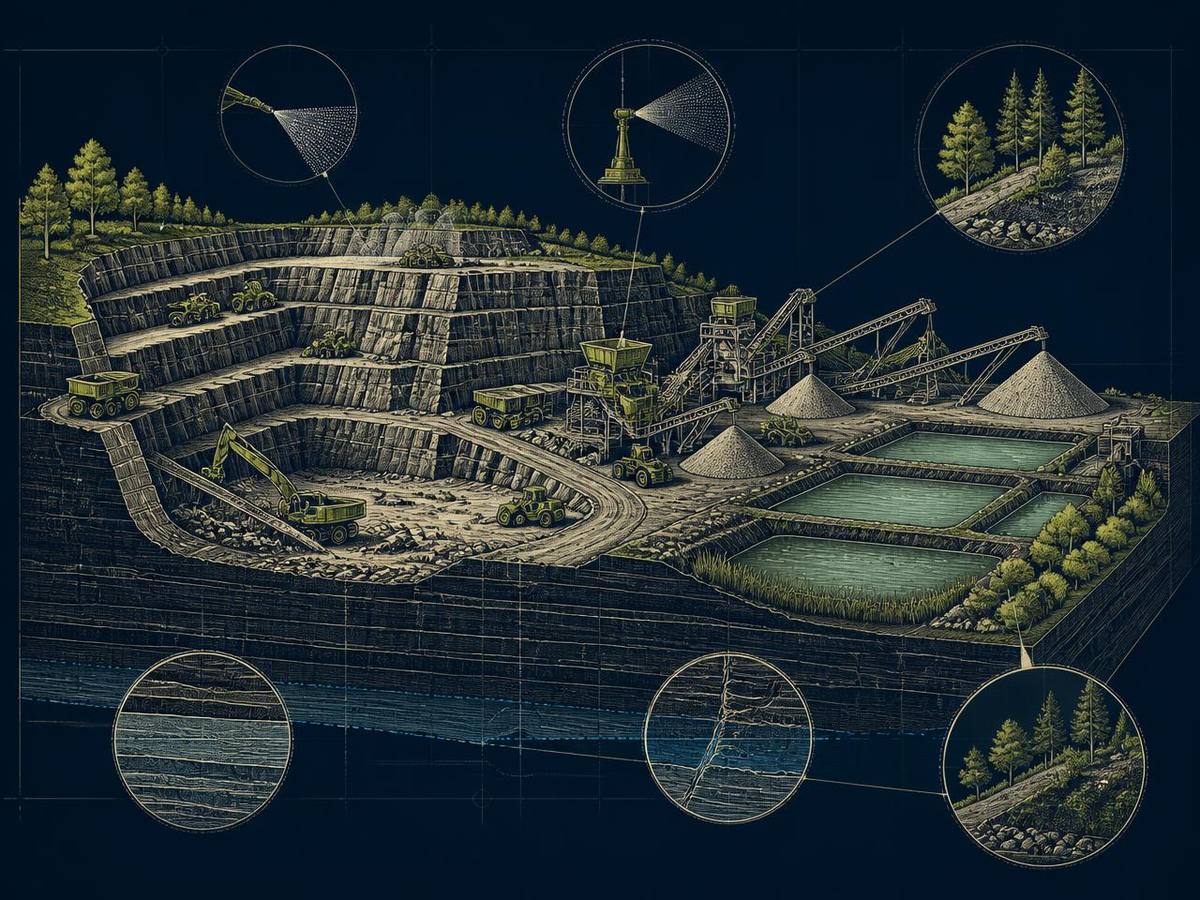
What environmental support does a quarry need?
Two stages: the planning application, with its EIA report, screening and Appropriate Assessment; and then years of monitoring dust, noise, blasting and water against the conditions the permission sets. We prepare the reports and run the monitoring.
Verdé’s environmental expertise in the quarrying and aggregates sector plays a crucial role in helping our clients maintain their compliance, minimise their environmental footprint, mitigate risks, and contribute to the sustainable development of communities and ecosystems. Verdé assist our clients in the planning permission process and application, providing all the necessary environmental expertise and required reporting.
Typical challenges we solve
- Planning permission process and application support
- Environmental regulations and permitting compliance
- Air, noise, water and soil sampling and analysis
- EIAR, Appropriate Assessment Screening and Natura Impact Statements
This page is for operators of sand, gravel and rock quarries and aggregates sites in Ireland. Your planning conditions set the limits that apply to your site; this page uses the EPA guideline values as the reference.
Is this right for you?
This is a fit if
- You are applying for planning permission for a new or extended quarry.
- You need an EIAR chapter, EIA screening or Appropriate Assessment.
- You need dust, noise, blast, water or soil monitoring for your conditions.
- A neighbour or the council has raised dust, noise or blasting.
This is not a fit if
- You need blast design or explosives supply.
- You need mineral prospecting or resource surveys.
For blast design, your shotfirer leads. For the monitoring of every blast, and the reports behind the planning permission, we can help.
Does a quarry need an EIA report?
A new or extended quarry needs one when the area of extraction would be greater than 5 hectares, under Schedule 5 of the Planning and Development Regulations. Smaller quarries are screened, and an Appropriate Assessment is needed where a Natura 2000 site could be affected.
The threshold is class 2(b) of Schedule 5, Part 2: extraction of stone, gravel, sand or clay. Planning authorities attach conditions on environmental management to the permission, and appeals now go to An Coimisiún Pleanála, which replaced An Bord Pleanála in June 2025 (Department of Housing).
We prepare EIAR chapters, screening reports and Natura Impact Statements for quarry applications (appropriate assessments). SACs are designated under the EU Habitats Directive (NPWS).
What dust, noise and blasting limits do quarries work to?
The EPA’s guidelines for the extractive industry recommend 350 mg/m² a day of dust deposition at the boundary, 55 dB(A) by day and 45 dB(A) at night at the nearest homes, 12 mm/s of blast vibration and 125 dB of air overpressure. Planning conditions set the limits that apply.
Quarry reading check
Check a dust, noise or blast reading against the EPA guideline values. Nothing is stored or sent.
Choose what you are checking, then enter the reading.
How the reading check decides
| What you enter | Threshold | What it triggers |
|---|---|---|
| Dust deposition, averaged over 30 days | more than 350 mg/m² a day | dust |
| Daytime noise, 08:00 to 20:00, LAeq over 1 hour | more than 55 dB(A) | daytime noise |
| Night-time noise, 20:00 to 08:00, LAeq over 1 hour | more than 45 dB(A) | night-time noise |
| Ground vibration, peak particle velocity | more than 12 mm/s | blast vibration |
| Air overpressure, linear maximum peak | more than 125 dB | air overpressure |
Guideline values from the EPA’s Environmental Management in the Extractive Industry (2006). Your planning conditions set the limits that apply to your site.
| What | Guideline value | Where it is measured | Source |
|---|---|---|---|
| Dust deposition | 350 mg/m² a day, averaged over 30 days | Site boundary | EPA, 2006 |
| Noise, daytime 08:00 to 20:00 | 55 dB(A) LAeq over 1 hour | Nearest noise-sensitive home | EPA, 2006 |
| Noise, night-time 20:00 to 08:00 | 45 dB(A) LAeq over 1 hour | Nearest noise-sensitive home | EPA, 2006 |
| Blast ground vibration | 12 mm/s peak particle velocity | Receiving location | EPA, 2006 |
| Blast air overpressure | 125 dB linear maximum peak | Receiving location | EPA, 2006 |
How are quarry dust, noise and blasting monitored?
Dust deposition is measured at the site boundary with Bergerhoff gauges and averaged over 30 days; noise is measured at the nearest noise-sensitive homes as hourly averages; and each blast is monitored for vibration and air overpressure where it is received. Results are reported against the planning conditions.
2017
Dust and particulate monitoring at a site boundary
Derry
- Long-term dust deposition monitoring with the Bergerhoff method
- Continuous PM10, PM5 and PM1 monitoring with telemetry
2023
Real-time noise and vibration monitoring
- Monitors at site boundaries and at sensitive neighbouring properties, on sites nationwide
For noise, the guidelines also say 95% of all readings should comply, and no reading should exceed the limit by more than 2 dB(A). Our air, noise and acoustics page covers the monitors and their telemetry.
What water monitoring does a quarry need?
Usually groundwater around the pit and the quality of any water pumped out or discharged, as the planning conditions or a discharge licence set. Our drilling team installs monitoring wells, and our environmental team samples them and reports the results.
2023
Groundwater supply in a disused basalt quarry
Co. Antrim
- Production well and bedrock monitoring wells, with a 3-day constant rate pumping test
- Report for the groundwater abstraction licence
A discharge to a river or stream needs a Section 4 licence from the local authority. Our hydrogeology page covers wells, sampling and abstraction.
Do quarries need an EPA licence?
Aggregate quarries are mainly regulated through planning permission and its conditions. The EPA licence class 1.3 covers minerals within the meaning of the Minerals Development Acts, which exclude stone, gravel, sand and clay except where listed, so most aggregates are non-scheduled minerals.
Class 1.3 of the First Schedule applies to metalliferous operations, and to other operations extracting or processing more than 200,000 tonnes of those minerals a year or with a total yield above 1,000,000 tonnes. The EPA’s guidelines note that construction aggregates and dimension stone come mostly from non-scheduled minerals.
What changes the job at a quarry?
The stage, the size and the neighbours: a new or extended quarry needs the planning reports first; a working quarry needs monitoring rounds; and the nearer the homes and the more sensitive the water around the pit, the more monitoring the conditions ask for.
If this is true of your quarry
If a new or extended quarry’s extraction area would be greater than 5 hectares
then an EIA report is mandatory with the planning application.
If the quarry could affect a Natura 2000 site
then it needs Appropriate Assessment screening, and a Natura Impact Statement where effects cannot be ruled out.
If dust deposition at the boundary is above 350 mg/m² a day
then it is over the EPA guideline value; check it against your planning conditions.
If a blast exceeds 12 mm/s of vibration or 125 dB of air overpressure
then it is over the EPA guideline values for blasting.
| Criterion | Verdé | What it means for you |
|---|---|---|
| Planning | EIAR chapters, screening and Natura Impact Statements | The environmental case for the application from one team. |
| Monitoring | Dust, noise, vibration, water and soil | Every common planning condition covered. |
| Real-time data | Telemetered dust and noise monitors | Results visible off site as they happen. |
| Wells | Our own drilling crews | Monitoring wells installed and sampled by one firm. |
| Staffed offices | Kilcoole, Castlebar and Cork | Teams in the east, west and south. |
Quarry questions we are asked most
Still have a question? Call 01 201 1260 or email info@verde.ie.
Does a quarry in Ireland need an EIA report?
A new or extended quarry needs an EIA report when the area of extraction would be greater than 5 hectares, under class 2(b) of Schedule 5 to the Planning and Development Regulations. Smaller quarries are screened to decide whether one is needed. Where a Natura 2000 site could be affected, Appropriate Assessment applies as well. Verdé prepares both.
What are the dust limits for a quarry?
The EPA’s guidelines for the extractive industry recommend total dust deposition of no more than 350 mg/m² a day at the site boundary, averaged over a 30-day period and measured with the Bergerhoff method. Your planning conditions set the limit that applies to your quarry. Verdé runs the gauges, sends the samples for analysis and reports the results against those conditions.
What noise limits apply to a quarry?
The EPA guidelines recommend 55 dB(A) by day, from 08:00 to 20:00, and 45 dB(A) at night, from 20:00 to 08:00, as hourly LAeq values at the nearest noise-sensitive homes. They add that 95% of readings should comply and none should exceed the limit by more than 2 dB(A). Your planning conditions set the limits that apply.
What are the blasting limits for a quarry?
The EPA guidelines recommend a peak particle velocity of no more than 12 mm/s for ground vibration, measured in any of three directions at the receiving location, and an air overpressure of no more than 125 dB as a linear maximum peak, with a 95% confidence limit. Planning conditions set the limits that apply, and every blast is monitored against them.
Can Verdé install groundwater monitoring wells at a quarry?
Yes. Our drilling team installs monitoring wells and our environmental team samples and reports on them. In a disused basalt quarry in Co. Antrim in 2023, we supervised the drilling of a production well for an anaerobic digestion plant, installed bedrock monitoring wells, ran a 3-day constant rate pumping test and prepared the hydrogeological report for its groundwater abstraction licence application.
Do quarries need an EPA licence?
Aggregate quarries are mainly regulated through planning permission and its conditions. The EPA licence class 1.3 covers minerals within the meaning of the Minerals Development Acts, which exclude stone, gravel, sand and clay except where listed. It applies to metalliferous operations and to operations above 200,000 tonnes a year. Other activities on site can need their own licences.
What is a Natura Impact Statement?
It is the report prepared at Appropriate Assessment stage when a project, such as a new or extended quarry, could affect a Natura 2000 site and screening cannot rule out significant effects. The planning authority uses it to make its decision. Verdé prepares Appropriate Assessment screening reports and Natura Impact Statements for quarry applications.
Terms used on this page
- Dust deposition
- Dust deposition is the mass of dust settling on an area each day, in mg/m², measured with Bergerhoff gauges.
- LAeq
- LAeq is the average A-weighted sound level over a set period, such as one hour.
- Peak particle velocity
- Peak particle velocity is the highest speed of ground movement during a blast, in mm/s.
- Air overpressure
- Air overpressure is the pressure wave in air from a blast, measured in dB.
- Non-scheduled minerals
- Non-scheduled minerals include the stone, gravel, sand and clay that the Minerals Development Acts largely leave out.
Sources and further reading
- Environmental Management in the Extractive Industry (Non-Scheduled Minerals)Environmental Protection Agency, 2006. Guideline limits for dust, noise, blast vibration and air overpressure.
- Current EIA screening thresholds (Schedule 5, Part 2)Department of Housing, Local Government and Heritage, checked 3 November 2026. The project sizes above which an EIA report is mandatory, for applications lodged up to 25 November 2026.
- An Coimisiún Pleanála, Ireland’s national independent planning body, launchedDepartment of Housing, Local Government and Heritage, 2025. An Coimisiún Pleanála replaced An Bord Pleanála on 18 June 2025.
- Special Areas of ConservationNational Parks and Wildlife Service, checked 3 November 2026. What SACs are and how Natura 2000 sites are designated.
- First Schedule to the EPA Act 1992, as amendedEnvironmental Protection Agency, checked 3 November 2026. The activity classes and capacity thresholds that bring a site under an EPA licence.
Tell us about the quarry
What we ask for
- The quarry location
- The planning or licence conditions in place
- Current monitoring results
- Details of any water discharges
- Any complaint or regulator correspondence
Reply
Within one working day.
For a spill or pollution incident, phone 0818 714 002 at any hour. The duty engineer confirms the response on the call.
Office 01 201 1260 or info@verde.ie
Related pages
- Air, noise and acousticsDust, noise and vibration monitoring with telemetry.
- Appropriate assessmentsScreening and Natura Impact Statements.
- Environmental consultancyEIAR chapters and planning support.
- Hydrogeology and groundwaterWells, sampling and abstraction.
- DrillingMonitoring wells by our own crews.
- Waste & RecyclingLicensing and monitoring for waste facilities.