
Sector
Agriculture licensing, water and spill support for farms and agri-food
Poultry units over 40,000 places, and pig units over 2,000 production places or 750 sow places, fall in classes 6.1 and 6.2 of the EPA Act’s First Schedule. They need an EPA licence.
Last updated by Verdé Environmental Group
Key takeaways
- Poultry units over 40,000 places need an EPA licence under class 6.1.
- Pig units need one above 2,000 production pig places or 750 sow places.
- Excess nutrients, mainly from agriculture, are the biggest challenge for Irish waters (EPA, 2025).
- Oil leaking on a farm? Keep it out of drains and streams, then call 0818 714 002.
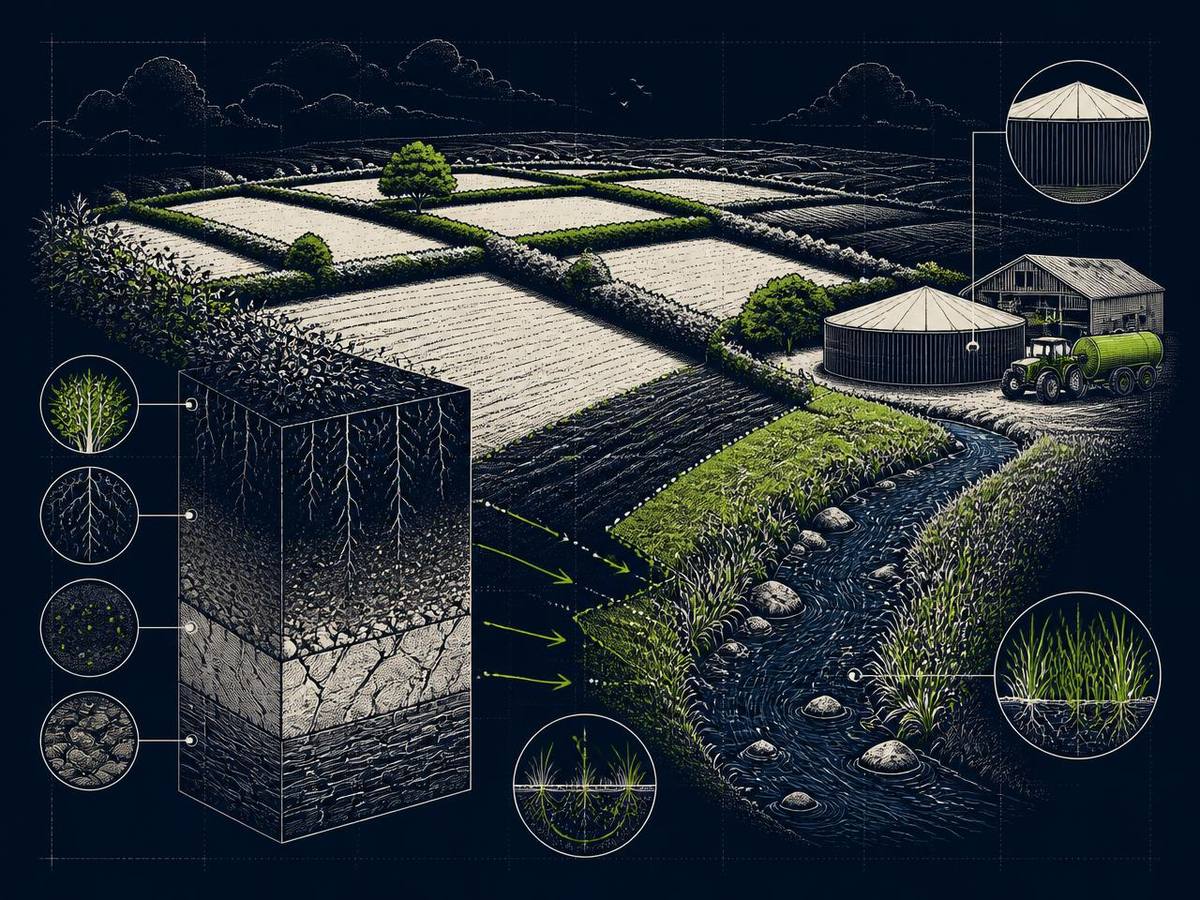
What environmental support does a farm or agri-food business need?
Most farm enquiries are about one of four things: whether an intensive unit needs an EPA licence, what is happening to the water around the farm, an oil or fuel leak, or a planning application near a protected site. We cover all four from one team.
Verdé provides environmental consultancy to intensive agriculture and agri-food operators: IE licensing, groundwater and surface water assessment, and Appropriate Assessment for development near protected sites.
Typical challenges we solve
- IE licensing for intensive agriculture installations
- Groundwater and surface water monitoring around farms
- Heating oil, diesel and fuel leaks on farms
- Appropriate Assessment where protected sites may be affected
This page is for farm businesses and agri-food operators in Ireland. It covers EPA licensing for pig and poultry units, water monitoring, oil and fuel leaks, and protected sites. It does not cover nutrient management plans or Nitrates advice.
Is this right for you?
This is a fit if
- You run, or plan, a poultry or pig unit near the class 6.1 or 6.2 thresholds.
- Heating oil, diesel or fuel has leaked on the farm, or reached a drain, ditch or stream.
- A planning application for farm buildings is close to a protected site.
- You need groundwater or stream water quality checked around the farm.
This is not a fit if
- You need a nutrient management plan or Nitrates advice.
- You need farm building design or planning drawings.
For nutrient plans and Nitrates rules, start with your agricultural adviser. We can still sample the water and deal with a spill.
Does a pig or poultry farm need an EPA licence?
Yes, above set sizes. Poultry installations over 40,000 places fall in class 6.1 of the EPA Act’s First Schedule, and pig installations over 750 sow places or 2,000 places for production pigs over 30 kg fall in class 6.2. First Schedule activities need an EPA licence, and the EPA decides.
Pig and poultry licence check
Enter the places your houses can hold. Nothing is stored or sent.
Class 6.1 applies above 40,000 places.
Class 6.2 applies above 2,000 production pig places.
Class 6.2 also applies above 750 sow places.
Enter the places your houses can hold. Leave a box empty if it does not apply to you.
How the licence check decides
| What you enter | Threshold | What it triggers |
|---|---|---|
| Poultry places, all houses together | more than 40,000 places | EPA licence class 6.1 |
| Production pig places, pigs over 30 kg | more than 2,000 places | EPA licence class 6.2 |
| Sow places | more than 750 places | EPA licence class 6.2 |
Thresholds from the First Schedule to the EPA Act 1992, classes 6.1 and 6.2. The EPA decides each case.
The classes are written as capacity, so the number of places your houses can hold decides it, not the number of animals on a given day. Sow places and production pig places are counted against separate thresholds.
The EPA says intensive agriculture licence holders have specific annual reporting requirements and guidance documents (EPA). We check your figures against the classes and prepare the application and the environmental information that goes with it.
What is affecting the water around farms?
Excess nutrients, mainly from agriculture, are the biggest challenge for Irish waters. The EPA’s 2019 to 2024 assessment found 52% of rivers, lakes, estuaries and coastal waters in satisfactory ecological condition, down from 54% in 2016 to 2021.
| Assessment period | Satisfactory | Not satisfactory | Source |
|---|---|---|---|
| 2016 to 2021 | 54% | 46% | EPA, 2025 |
| 2019 to 2024 | 52% | 48% | EPA, 2025 |
The EPA’s indicators report for 2025, published in June 2026, says the main source of excess nitrate in the environment is agriculture (EPA). We sample groundwater from wells and boreholes, and surface water from streams and drains, so a farm can see its own effect as measured results.
Where a well or a stream may have been affected, our hydrogeology team traces where the water comes from and where it goes.
What should a farmer do if heating oil or diesel leaks?
Stop the source if it is safe to do so, keep the oil out of drains and watercourses, and call 0818 714 002 at any hour. If fish are dead or in distress in a river or stream, Inland Fisheries Ireland’s 24-hour line is 0818 34 74 24.
The clean-up then runs in four stages: containment, recovery, remediation and validation, with sampling to show the result. The stages are on our oil spill clean-up page, and the fisheries line is on the Inland Fisheries Ireland contact page.
If the farm is insured, tell your insurer early. Our insurance page sets out what a loss adjuster needs from the clean-up.
What if the farm is near a protected site?
Special Areas of Conservation and Special Protection Areas make up the Natura 2000 network. A project that could affect one needs Appropriate Assessment screening, and a Natura Impact Statement where significant effects cannot be ruled out.
2023
Freshwater pearl mussel survey after an oil spill
Co. Galway
- Survey carried out with Jennings O’Donovan & Partners following an oil spill incident
SACs are designated under the EU Habitats Directive (NPWS). We prepare screening reports and Natura Impact Statements for farm buildings, stores and other agricultural development (appropriate assessments).
What changes the job on a farm?
Four things change what a farm needs from us: the type and size of the unit, whether anything has reached water, how close the farm is to a protected site, and whether an insurer is involved.
If this is true on your farm
If the poultry houses together have capacity for more than 40,000 places
then the installation falls in class 6.1 and needs an EPA licence.
If the unit has more than 750 sow places, or more than 2,000 places for production pigs over 30 kg
then it falls in class 6.2 and needs an EPA licence.
If oil or fuel has reached a drain, ditch, stream or well
then call 0818 714 002 straight away; dead or distressed fish are also reported to Inland Fisheries Ireland on 0818 34 74 24.
If a planning application could affect a Natura 2000 site
then it needs Appropriate Assessment screening before the planning authority decides.
| Criterion | Verdé | What it means for you |
|---|---|---|
| Licensing | EPA licence applications for intensive pig and poultry units | One team prepares the application and the environmental information behind it. |
| Water | Groundwater and surface water sampling | Measured results instead of assumptions about the farm. |
| Spills | 24-hour line, 0818 714 002 | Someone answers at any hour, including weekends. |
| Protected sites | Appropriate Assessment screening and Natura Impact Statements | Evidence the planning authority can rely on. |
| Staffed offices | Kilcoole, Castlebar and Cork | Teams in the east, west and south. |
Farm questions we are asked most
Still have a question? Call 01 201 1260 or email info@verde.ie.
Does a pig or poultry farm in Ireland need an EPA licence?
Yes, once it passes set capacities. Poultry installations over 40,000 places fall in class 6.1 of the EPA Act’s First Schedule, and pig installations over 750 sow places or 2,000 places for production pigs over 30 kg fall in class 6.2. Activities in the First Schedule need an EPA licence. The EPA decides each case; Verdé checks your numbers and prepares the application.
Do the licence thresholds count animals or places?
Places. Both classes are written as capacity: poultry installations where the capacity exceeds 40,000 places, and pig installations where it exceeds 750 sow places or 2,000 production pig places. So the number of places your houses can hold decides it, not the number of animals on a given day. If you are close to a threshold, check before you expand.
What should a farmer do if heating oil or diesel leaks?
Stop the source if it is safe, keep the oil away from drains, ditches and watercourses, and call Verdé’s 24-hour line on 0818 714 002. If dead or distressed fish appear in a river or stream, also call Inland Fisheries Ireland on 0818 34 74 24. The clean-up then runs through containment, recovery, remediation and validation, with sampling to show the result.
How is water quality checked around a farm?
By sampling. We take groundwater samples from wells and boreholes, and surface water samples from streams and drains, have them analysed, and report the results. Measured results show whether the farm is affecting the water. That matters because the EPA names excess nutrients, mainly from agriculture, as the biggest challenge for Irish waters, and agriculture as the main source of excess nitrate.
When does a farm development need an Appropriate Assessment?
When it could affect a Natura 2000 site, meaning a Special Area of Conservation or a Special Protection Area. The first stage is screening. If significant effects on the site cannot be ruled out, a Natura Impact Statement follows, and the planning authority uses it to decide. Verdé prepares both the screening report and the Natura Impact Statement.
Do licensed pig and poultry farms report to the EPA every year?
Yes. EPA licensees submit an Annual Environmental Report, and the EPA says intensive agriculture licence holders have specific annual reporting requirements and guidance documents. The report gives a concise summary of the year’s environmental performance, including emissions monitoring results. Check your licence for exactly what yours must contain and when it is due, and we can help prepare it.
Can Verdé help after an oil spill reaches a river?
Yes. We contain the spill, recover the oil, and sample the water and the soil. Protected species can matter too: in 2023 we carried out a freshwater pearl mussel survey in Co. Galway after an oil spill, with Jennings O’Donovan & Partners. Call 0818 714 002 first, and Inland Fisheries Ireland on 0818 34 74 24 if fish are affected.
Terms used on this page
- Places
- Places are the number of animals an installation has the capacity to house. The EPA licence classes for pigs and poultry are set in places.
- Production pig place
- A production pig place is a place for a pig over 30 kg reared for production. Class 6.2 counts these separately from sow places.
- First Schedule
- The First Schedule to the EPA Act 1992 lists the activities, and their thresholds, that need an EPA licence.
- Natura 2000
- Natura 2000 is the EU network of protected sites: Special Areas of Conservation and Special Protection Areas.
- Natura Impact Statement
- A Natura Impact Statement is the report prepared at Appropriate Assessment stage when a project could affect a Natura 2000 site.
Sources and further reading
- First Schedule to the EPA Act 1992, as amendedEnvironmental Protection Agency, checked 3 November 2026. The activity classes and capacity thresholds that bring a site under an EPA licence.
- Water quality has improved in some areas but continues to decline overallEnvironmental Protection Agency, 2025. 52% of rivers, lakes, estuaries and coastal waters in satisfactory ecological condition in 2019 to 2024, down from 54% in 2016 to 2021.
- Faster action is needed, as water quality shows little overall improvement in 2025, says EPAEnvironmental Protection Agency, 2026. Agriculture is the main source of excess nitrate; agriculture and urban wastewater are the main sources of excess phosphorus.
- Annual Environmental Report (AER)Environmental Protection Agency, checked 3 November 2026. The 31 March deadline and what the report covers.
- Special Areas of ConservationNational Parks and Wildlife Service, checked 3 November 2026. What SACs are and how Natura 2000 sites are designated.
- Contact usInland Fisheries Ireland, checked 3 November 2026. The 24-hour line for pollution and dead or distressed fish in inland waters.
Tell us what is happening on the farm
What we ask for
- The farm address or Eircode
- What happened or what you need, for example a leak or a planning report
- For a licence question, the places in each house
- Photographs, if something has leaked
- Any letter from the local authority or the EPA
Reply
Within one working day.
For a spill or pollution incident, phone 0818 714 002 at any hour. The duty engineer confirms the response on the call.
Office 01 201 1260 or info@verde.ie
Related pages
- EPA and IPC licensingWhich authorisation applies, and the application steps.
- Hydrogeology and groundwaterWells, abstraction thresholds and water monitoring.
- Appropriate assessmentsScreening and Natura Impact Statements.
- Oil spill clean-upThe four clean-up stages and the 24-hour line.
- Environmental consultancyEvery assessment we offer, by project stage.
- Food & DrinkLicensing and water for processors and dairies.