Sector
Waste & recycling licensing, monitoring and closure for waste facilities
Landfills taking more than 10 tonnes of waste a day, or with a total capacity over 25,000 tonnes, need an EPA licence under class 11.5 of the First Schedule, unless they take only inert waste.
Last updated by Verdé Environmental Group
Key takeaways
- Non-hazardous waste recovery over 75 tonnes a day needs an EPA licence; disposal over 50 tonnes.
- Landfill gas triggers outside the waste body: 1% methane or 1.5% carbon dioxide.
- Smaller activities may need a council waste facility permit or certificate of registration instead.
- Verdé advises waste operators and classifies waste, but does not collect it.
What environmental support does a waste facility need?
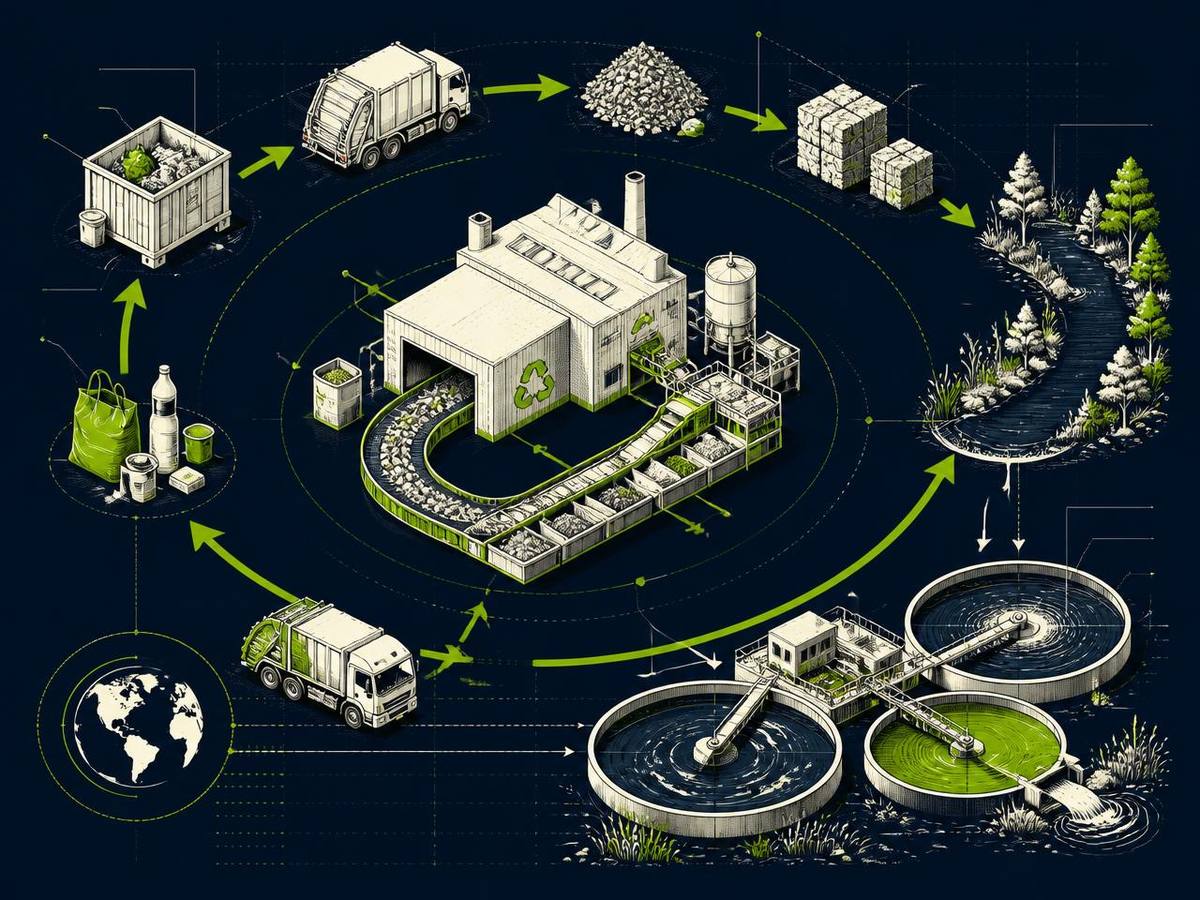
Three things, mostly: the right authorisation for the activity and its size, monitoring that shows the facility is within its licence, and a plan for closure. We prepare licence, permit and registration applications, run the monitoring and annual reporting, and write the closure plan.
Verdé supports operators across waste transfer, recovery, landfill and end-of-life sectors, preparing EPA waste licence, permit and registration applications, running licence monitoring and reporting, and planning site closure.
Typical challenges we solve
- EPA waste licence, waste facility permit and certificate of registration applications
- Groundwater, dust, odour and noise monitoring for licence conditions
- Site closure planning
- Waste classification and Annual Environmental Reports
This page is for operators of waste transfer, recovery, landfill and anaerobic digestion facilities in Ireland. If you need waste collected from your home or business, use a permitted waste collector; Verdé does not collect waste.
Is this right for you?
This is a fit if
- You run, or plan, a waste transfer, recovery, landfill or anaerobic digestion facility.
- You need to know whether your activity needs a licence, a permit or a registration.
- You need licence monitoring, an Annual Environmental Report or a closure plan.
- You have landfill gas readings near or above the trigger levels.
This is not a fit if
- You need household or business waste collected.
- You need a skip or a waste haulier.
For collection, use a permitted waste collector. For any facility that receives, treats or deposits waste, we can help.
Which waste activities need an EPA licence?
Those in class 11 of the First Schedule above set capacities: for example, disposal of non-hazardous waste over 50 tonnes a day, recovery over 75 tonnes a day, anaerobic digestion alone over 100 tonnes a day, and landfills taking more than 10 tonnes a day. Smaller activities may need a council permit or registration.
| Activity | Threshold | Class |
|---|---|---|
| Disposal or recovery of hazardous waste by a listed activity | More than 10 tonnes a day | 11.2 |
| Incineration of non-hazardous waste | More than 3 tonnes an hour | 11.3(a) |
| Incineration of hazardous waste | More than 10 tonnes a day | 11.3(b) |
| Disposal of non-hazardous waste by a listed activity | More than 50 tonnes a day | 11.4(a) |
| Recovery of non-hazardous waste by a listed activity | More than 75 tonnes a day | 11.4(b) |
| Anaerobic digestion as the only treatment | More than 100 tonnes a day | 11.4(c) |
| Landfill, other than inert waste only | More than 10 tonnes a day, or over 25,000 tonnes in total | 11.5 |
Below these sizes, a waste activity may need a waste facility permit or a certificate of registration, usually from the local authority, under S.I. No. 821 of 2007 (EPA). We prepare waste licence, permit and registration applications, and the Annual Environmental Report once a licence is running (EPA and waste licensing).
What are the landfill gas trigger levels?
In boreholes outside the waste body, the EPA’s landfill monitoring manual sets trigger levels of 1% methane or 1.5% carbon dioxide by volume. A reading at or above either level needs investigating against the licence. The check below tests a reading against both levels.
Landfill gas reading check
Enter a perimeter borehole reading. Gas inside a building is an emergency: leave the area and call 112 or 999. Nothing is stored or sent.
The trigger is 1% v/v or more, in a borehole outside the waste body.
The trigger is 1.5% v/v or more, in a borehole outside the waste body.
Enter a reading from a perimeter borehole outside the waste body.
How the landfill gas check decides
| What you enter | Threshold | What it triggers |
|---|---|---|
| Methane reading | at least 1% v/v | methane |
| Carbon dioxide reading | at least 1.5% v/v | carbon dioxide |
Trigger levels from Table 7.1 of the EPA’s Landfill Monitoring manual, for boreholes outside the waste body. Your licence sets the monitoring frequency and what happens after a trigger.
| What is monitored | Where it is shown | Level or rule |
|---|---|---|
| Landfill gas, methane | Perimeter boreholes outside the waste body | Trigger at 1% v/v or more |
| Landfill gas, carbon dioxide | Perimeter boreholes outside the waste body | Trigger at 1.5% v/v or more |
| Leachate | The base of the waste body | As the licence sets |
| Groundwater | Monitoring wells | As the licence sets |
| Surface water | The nearby stream | As the licence sets |
| Dust, odour, noise and weather | Around the site | As the licence sets |
What does a landfill monitoring programme cover?
For a non-hazardous landfill, the EPA manual lists the minimum as surface water, groundwater, leachate, landfill gas and its combustion products, odour, noise, weather, dust, topography and stability, ecology and archaeology. Licensed landfills monitor at the frequencies their licence sets.
We install groundwater monitoring wells and sample them, measure dust deposition with the Bergerhoff method, survey noise, and assess odour to the EPA’s AG5 method. The results feed the licence reporting.
Closure plans set out how a facility will be shut down and monitored afterwards. We prepare them as part of licensing.
When does a new waste facility need an EIA report?
An EIA report is mandatory for installations for the disposal of waste with an annual intake greater than 25,000 tonnes, under Schedule 5 of the Planning and Development Regulations. Smaller facilities are screened, and Appropriate Assessment applies wherever a Natura 2000 site could be affected.
2023
Groundwater supply for an anaerobic digestion plant
Co. Antrim
- Production well to add to the mains supply, at a plant in a disused basalt quarry
- Step tests and a 3-day constant rate pumping test
- Hydrogeological report for the groundwater abstraction licence
The thresholds are in Schedule 5. For new facilities we prepare EIAR chapters, including soils, geology and hydrogeology, and the water supply evidence a plant needs.
Does Verdé collect waste?
No. Verdé is an environmental consultancy and contractor. We advise waste operators, prepare licence, permit and registration applications, and classify waste, but we do not run a waste collection service, so our advice has no stake in where the waste goes.
For excavated soil and stone, we decide whether material is a by-product, a non-hazardous waste or a hazardous waste before it moves, and keep the audit trail for every load (waste management).
What changes the job at a waste facility?
The activity and its daily tonnage decide the authorisation; the authorisation decides the monitoring and reporting; and the stage of the facility, new, running or closing, decides which reports come first.
If this is true of your facility
If a landfill takes more than 10 tonnes of waste a day, or has a total capacity over 25,000 tonnes, and is not inert only
then it needs an EPA licence under class 11.5.
If a facility recovers more than 75 tonnes of non-hazardous waste a day by biological treatment or another listed activity
then it needs an EPA licence under class 11.4(b); for anaerobic digestion alone the threshold is 100 tonnes a day.
If a perimeter borehole reads 1% methane or 1.5% carbon dioxide or more
then the reading is at a trigger level and needs investigating.
If a new disposal installation will take more than 25,000 tonnes a year
then an EIA report is mandatory with the planning application.
| Criterion | Verdé | What it means for you |
|---|---|---|
| Authorisations | Waste licences, waste facility permits and certificates of registration | The right route identified before the application starts. |
| Reporting | Annual Environmental Report preparation | Licence reporting planned around the 31 March deadline. |
| Monitoring | Groundwater, dust deposition, odour and noise | Evidence measured to EPA guidance. |
| Independence | We do not collect waste | Advice with no stake in where the waste goes. |
| Staffed offices | Kilcoole, Castlebar and Cork | Teams in the east, west and south. |
Waste facility questions we are asked most
Still have a question? Call 01 201 1260 or email info@verde.ie.
Which waste activities need an EPA licence in Ireland?
Those in class 11 of the First Schedule to the EPA Act above set capacities. Examples include disposal of non-hazardous waste over 50 tonnes a day, recovery over 75 tonnes a day, anaerobic digestion alone over 100 tonnes a day, hazardous waste treatment over 10 tonnes a day, and landfills taking over 10 tonnes a day unless they take inert waste only.
What are the landfill gas trigger levels?
The EPA’s Landfill Monitoring manual sets trigger levels for boreholes outside the waste body of 1% methane or 1.5% carbon dioxide by volume, or more. A reading at either level needs investigating against the licence conditions, to find where the gas is coming from. Gas found inside a building is an emergency: leave the area and call 112 or 999.
What is a certificate of registration?
It authorises certain smaller waste activities in Ireland instead of a full waste licence. Certificates of registration and waste facility permits come under the Waste Management (Facility Permit and Registration) Regulations, S.I. No. 821 of 2007, and are usually issued by the local authority. The activity and its size decide which applies. Verdé works out the right route and prepares the application.
Does Verdé collect waste?
No. Verdé is an environmental consultancy and contractor. We advise waste operators, prepare licence, permit and registration applications, and classify waste, but we do not run a waste collection service. For collection, use a permitted waste collector. For any facility that receives, treats or deposits waste, we can help with the authorisation and the monitoring.
What does landfill monitoring cover?
For a non-hazardous landfill, the EPA manual lists the minimum as surface water, groundwater, leachate, landfill gas and its combustion products, odour, noise, weather conditions, dust, topography and stability, ecology and archaeology. Licensed landfills monitor at the frequencies their licence sets, and the results feed the Annual Environmental Report due by 31 March.
Does a new waste facility need an EIA report?
An EIA report is mandatory for installations for the disposal of waste with an annual intake greater than 25,000 tonnes, under Schedule 5 of the Planning and Development Regulations. Smaller facilities are screened to decide whether one is needed. Where a Natura 2000 site could be affected, Appropriate Assessment is needed as well. Verdé prepares EIAR chapters and screening reports.
Can Verdé help an anaerobic digestion plant?
Yes. Anaerobic digestion as the only treatment needs an EPA licence above 100 tonnes a day, under class 11.4(c). Below that, a permit or registration may apply. In 2023 Verdé developed a groundwater supply for an anaerobic digestion plant in a disused quarry in Co. Antrim, with pumping tests and the report for its abstraction licence.
Terms used on this page
- Waste body
- The waste body is the mass of waste deposited in a landfill. Gas trigger levels apply in boreholes outside it.
- Leachate
- Leachate is liquid that has passed through or come from waste, collected at the base of a landfill.
- Trigger level
- A trigger level is a reading that, once reached, means the cause must be investigated and acted on.
- Certificate of registration
- A certificate of registration authorises certain smaller waste activities, usually issued by the local authority.
- Waste facility permit
- A waste facility permit, usually issued by the local authority, covers waste activities below the EPA licence thresholds.
- Anaerobic digestion
- Anaerobic digestion breaks down organic waste without oxygen, producing biogas and digestate.
Sources and further reading
- First Schedule to the EPA Act 1992, as amendedEnvironmental Protection Agency, checked 3 November 2026. The activity classes and capacity thresholds that bring a site under an EPA licence.
- The waste permit and certificate of registration databaseEnvironmental Protection Agency, checked 3 November 2026. Local authority permits and registrations under S.I. No. 821 of 2007.
- Landfill Manuals: Landfill Monitoring, 2nd editionEnvironmental Protection Agency, 2003. The landfill gas trigger levels and what a monitoring programme covers.
- Current EIA screening thresholds (Schedule 5, Part 2)Department of Housing, Local Government and Heritage, checked 3 November 2026. The project sizes above which an EIA report is mandatory, for applications lodged up to 25 November 2026.
- Odour Impact Assessment Guidance for EPA Licensed Sites (AG5)Environmental Protection Agency, 2021 edition. The field method for assessing odour around licensed sites.
Tell us about the facility
What we ask for
- The facility address
- Your licence, permit or registration number, if you have one
- The waste types and daily tonnages
- Recent monitoring results
- Any letter from the EPA or the local authority
Reply
Within one working day.
For a spill or pollution incident, phone 0818 714 002 at any hour. The duty engineer confirms the response on the call.
Office 01 201 1260 or info@verde.ie
Related pages
- EPA and waste licensingLicences, permits and registrations, and which applies.
- Waste managementClassification, by-products and the audit trail.
- Contaminated landInvestigation and remediation around facilities.
- Air, noise and acousticsOdour, dust and noise to EPA guidance.
- Hydrogeology and groundwaterWells, sampling and abstraction licensing.
- QuarriesPlanning and monitoring for extraction sites.