
Site investigation drilling in Ireland, by our own crews
Cable percussion, rotary and window sampling, run by Verdé crews from Kilcoole, Castlebar and Cork.
Last updated
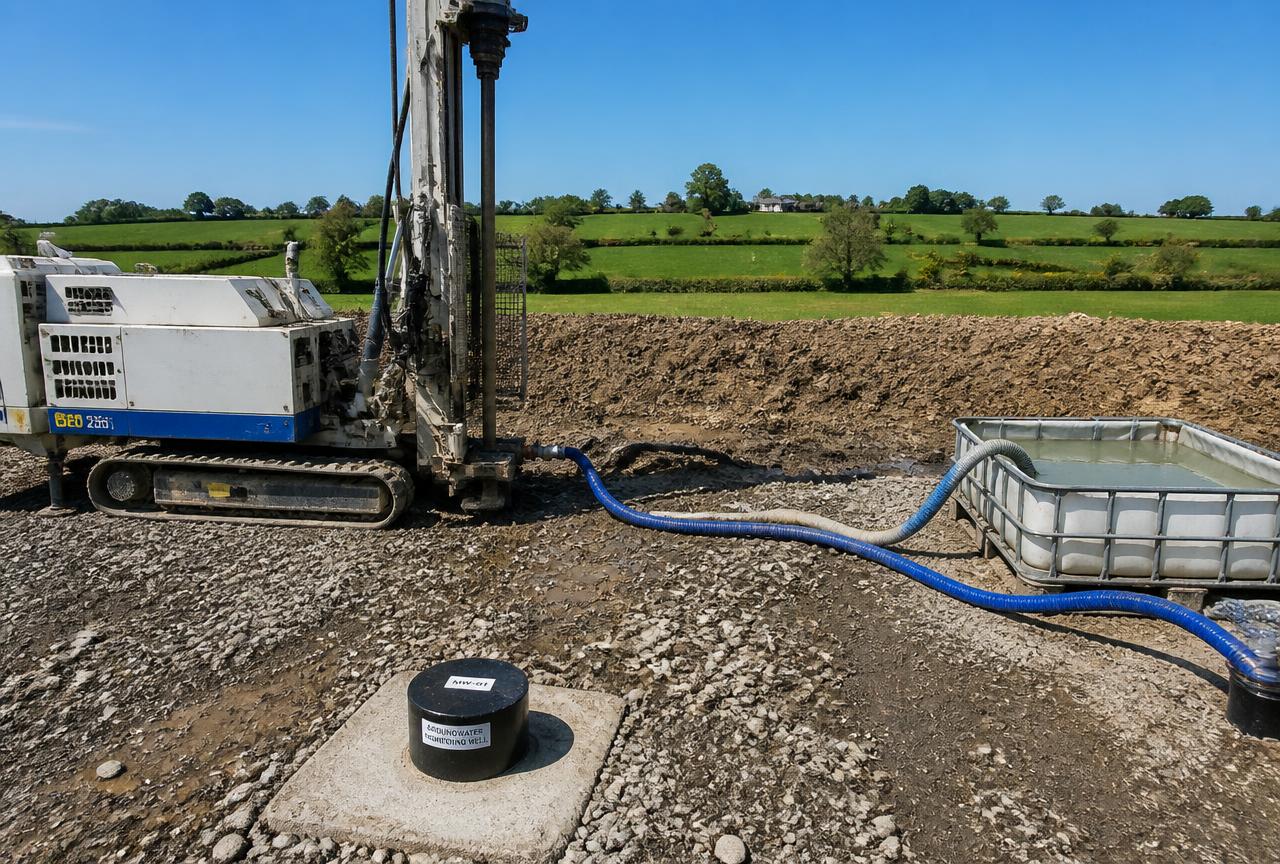
Verdé drills site investigation boreholes and trial pits across Ireland with its own rigs and crews. Holes can be finished as groundwater or ground-gas monitoring wells, dewatering wells or abstraction boreholes. Every hole is logged, every well gets an installation record, and the findings are written up in one factual report.
This page covers drilling in Ireland: boreholes and trial pits to see, sample and monitor the ground. Groundwater models and abstraction dossiers sit on Hydrogeology, and full groundwater control design sits on Construction dewatering. Both are part of our wider environmental consultancy work. Verdé’s Nigeria work runs from its Lagos office.
Key takeaways
- Verdé drills with its own rigs and crews: cable percussion, rotary, window sampling and trial pits.
- Investigation boreholes can be finished as groundwater or ground-gas monitoring wells.
- Every hole ends in a log, and every well ends in an installation record.
- Geological Survey Ireland's geotechnical viewer maps the boreholes and site investigations that industry has submitted. Check it before drilling.
- Abstraction boreholes come with test pumping and yield data for the EPA step.
Is this right for you?
This is a fit if
- You need boreholes or trial pits for a geotechnical or environmental ground investigation in Ireland.
- You need groundwater or ground-gas monitoring wells installed, developed, sampled or decommissioned.
- You are drilling an abstraction borehole and need test pumping and yield data.
- Your excavation needs deep wells or wellpoints for groundwater control.
This is not a fit if
- Oil or fuel is leaking right now: call the 24/7 spill line on 0818 714 002.
- You need building materials sampled for asbestos: see asbestos surveys and testing.
- You only need a desk review of existing ground data, with no new holes.
If it is not a fit: desk reviews and groundwater models go to Hydrogeology, and live spills go to 24/7 spill response.
Which drilling method suits your ground?
Ground type and purpose decide the method. Cable percussion suits soils, rotary drilling suits rock and deeper wells, window sampling suits fast shallow sampling, and trial pits show the ground in section. Verdé runs all four in-house. Most geotechnical boreholes in Ireland are 0 to 30 metres deep (GSI).
Drilling Method Matcher
Three questions, one suggested method. Nothing you choose is stored or sent.
Choose a purpose, the ground and the access to see a suggested method.
How the matcher decides
| If you choose | We suggest | Why |
|---|---|---|
| Rock near the surface | Rotary drilling, with trial pits for the shallow layer | Rotary cuts rock that cable percussion cannot. |
| Geotechnical design data in soils | Cable percussion boreholes plus trial pits | Recovers soil samples and in-situ tests at set depths. |
| Contamination sampling | Window sampling plus trial pits, with monitoring wells where groundwater is a concern | Fast continuous cores and a clear view of made ground. |
| Groundwater or ground-gas monitoring well | The method that suits the ground, finished as a well | The hole is built so later samples come from the target depth. |
| Water supply or abstraction well | Rotary drilling, then test pumping and a yield assessment | Yield data supports the EPA registration or licence step. |
| Dewatering well | Deep wells or wellpoints, designed with the dewatering team | Groundwater control is sized from the dig, not the hole. |
| Narrow, low or indoor access | Window sampling or hand-dug pits | Smaller kit fits where a full rig cannot. |
| Not sure of the ground | Trial pits first, then boreholes where the pits stop | Pits show the shallow ground quickly and cheaply. |
How this works: the rules follow general ground investigation practice. Verdé confirms the method after reading your brief.
| Method | Best for | What it recovers | Can it become a well? |
|---|---|---|---|
| Cable percussion | Soils: clays, silts, sands and gravels | Disturbed and undisturbed soil samples, plus in-situ tests | Yes |
| Rotary | Rock, hard strata, deeper and production wells | Rock core or cuttings | Yes |
| Window sampling | Fast, shallow sampling on tight or contaminated sites | Continuous soil core in liners | Yes, small-diameter |
| Trial pit | Seeing the strata in section | Bulk samples and photos of the pit face | No |
What comes out of each borehole?
Records you can use. Every borehole and trial pit is logged, every monitoring well gets an installation record, abstraction holes get test pumping and yield data, and the investigation is written up as a factual report. A well that is no longer needed is decommissioned and recorded.
| Deliverable | What you use it for |
|---|---|
| Borehole and trial pit logs | Designers and consultants read the ground conditions from them. |
| Monitoring well installation records | They show where the screen sits, so later samples can be trusted. |
| Test pumping and yield data | They support the abstraction registration or licence step. |
| Ground investigation factual report | The single record of what was found, hole by hole. |
| Well decommissioning records | They close each well out once monitoring ends. |
How is a monitoring well built?
A monitoring well is a cased hole with a slotted screen at the depth you want to sample. A filter pack surrounds the screen, a bentonite seal stops surface water running down the outside, and a lockable cover protects the top. The screen depth decides what the samples can tell you.
| Part | What it does |
|---|---|
| Lockable cover | Protects the well head and stops tampering. |
| Surface seal | Stops surface water running down the outside of the casing. |
| Bentonite seal | Isolates the response zone from the ground above it. |
| Plain riser | Carries the sample line up to the surface. |
| Filter pack | Holds back fine soil around the screen. |
| Slotted screen | Lets groundwater or gas in at the target depth. |
| End cap | Closes the base of the casing. |
| Gas tap (gas wells) | Lets ground gas be read without opening the well. |
What do we check before drilling?
Three things: what records already exist, what is under the surface, and what the borehole will become. GSI's national borehole database shows the boreholes and site investigations already submitted near your site. Buried services and access are checked on site. A borehole that will supply 25 cubic metres of water a day or more must be registered with the EPA.
Helpful resource: GSI geotechnical data and maps: use this to find existing borehole records near your site before you brief us.
Checks that change the plan
If existing GSI logs sit near the site
then send their references with the brief, because they shape where new holes go.
If buried services may be present
then hole locations are cleared before any rig breaks ground.
If access is narrow, low or indoors
then window sampling or hand-dug pits replace the larger rig.
If the ground could be contaminated
then arisings are sampled and classified before they leave site, through our waste classification team.
If the finished borehole will supply 25 m³ or more in a day
then it goes on the EPA abstraction register, and from 2,000 m³ a day an EPA licence is needed (EPA).
If the pumping is a test or an investigation
then it is a listed exemption under the 2024 Regulations, within the conditions they set (EPA).
If a well is no longer needed
then it is decommissioned and a record is issued.
How does a drilling job run?
Seven steps from brief to report. You send the objective, location, access notes and any existing logs. Verdé fixes the method and hole locations, clears services, mobilises its own crew, drills, logs and samples, installs any wells, then issues the factual report.
Step 1: Brief and existing records
The objective, Eircode, access notes and any GSI or previous logs.
Step 2: Method and hole plan
Methods, depths and hole locations are fixed against the objective.
Step 3: Services clearance
Each location is checked for buried services before ground is broken.
Step 4: Mobilise
A Verdé crew and rig travel from the nearest base: Kilcoole, Castlebar or Cork.
Step 5: Drill, log and sample
Each hole is logged as it is drilled, and samples are taken at the agreed depths.
Step 6: Install, develop and survey wells
Where wells are part of the brief, they are built, developed and surveyed in.
Step 7: Factual report
Logs, installation records and test data are issued together in one report.
Who drills, and where?
Verdé’s own crews. Rigs and crews work from Kilcoole in Co. Wicklow, Castlebar in Co. Mayo and Cork, covering every county, with Galway appointments by arrangement. New drilling briefs get a reply within one working day.

| Criterion | Verdé | What it means for you |
|---|---|---|
| Methods in-house | Cable percussion, rotary, window sampling, trial pits | One crew can switch method when the ground changes. |
| Wells | Groundwater and ground gas: install, develop, sample, decommission | One contractor from the first hole to the last sample. |
| Coverage | All counties, from Kilcoole, Castlebar and Cork | Crews start from the nearest of three bases. |
| Reply time | Within one working day | Scoping starts the day after you send the brief. |
| Management systems | ISO 9001, ISO 14001, ISO 45001 | Certified quality, environmental and safety systems on site. |
Where has Verdé drilled recently?
On jobs from production wells to waste classification. Recent work includes supervising a production well for an anaerobic digester development, fourteen trial pits for a soil classification for Collen Construction, and a hydrogeological site investigation for a proposed cemetery.
2023
- Supervised the drilling and installation of a groundwater production well.
- The well augments the mains water supply to an anaerobic digester development.
2023
Soil Waste Classification
for Collen Construction
- Fourteen trial pits at key strategic positions around the site.
- Pits generally reached 2.0 to 3.0 m below ground level.
2023
- An environmental and hydrogeological site investigation.
- For a proposed cemetery on an existing greenfield site.
Questions about site investigation drilling
Still have a question? Call 01 201 1260 or email info@verde.ie.
Who does site investigation drilling in Ireland?
Verdé does, with its own rigs and crews based in Kilcoole, Castlebar and Cork, covering every county. The crews run cable percussion, rotary and window sampling boreholes and trial pits, and finish holes as monitoring, dewatering or abstraction wells. New briefs get a reply within one working day, and the work is run under ISO 9001, 14001 and 45001 systems.
Cable percussion vs rotary drilling: which do I need?
Cable percussion suits soils such as clays, sands and gravels, and recovers soil samples and in-situ tests at set depths. Rotary suits rock, hard strata and deeper or production wells, and recovers rock core or cuttings. Where soils sit over rock, one hole often needs both: cable percussion through the soils, then rotary once it reaches rock. The matcher above gives a first answer.
How deep do site investigation boreholes go in Ireland?
Most geotechnical boreholes in Ireland are 0 to 30 metres deep, according to Geological Survey Ireland’s borehole dataset. Depth follows the question being asked: foundation design, the depth of contamination, or the aquifer a well must reach. Rotary drilling goes deeper than cable percussion or window sampling. Send the investigation objective and the method and depth follow from it.
How much does a site investigation borehole cost in Ireland?
It depends on the method, the depth, the number of holes, site access and the samples and tests needed, so Verdé prices each job from the brief rather than quoting a flat rate. A brief with the Eircode, purpose, access notes and programme dates gets a reply within one working day, with the scope the price is based on.
Do I need to register a borehole with the EPA?
Only if it will supply 25 cubic metres or more in any 24 hours, according to the EPA; at 2,000 cubic metres or more an EPA licence is needed. Abstractions for testing or investigative reasons are a listed exemption under the 2024 Regulations, so test pumping a new hole within the conditions they set needs no registration. Verdé’s yield data then feeds the registration step.
Can an investigation borehole be turned into a monitoring well?
Yes. Once the hole is logged, a slotted screen, filter pack, bentonite seal and protective cover go in so groundwater or ground gas can be sampled later. Verdé installs, develops, samples and decommissions both groundwater and ground-gas wells, so the crew that drilled the hole can also run the monitoring.
What is the difference between a borehole and a trial pit?
A trial pit is dug by excavator, so you see the ground in section and take bulk samples near the surface. A borehole is drilled, so it reaches deeper ground, recovers soil or rock samples at set depths and can be finished as a monitoring well. Most investigations use both: pits for the shallow picture, boreholes for depth.
What happens to the soil that comes out of the hole?
Drilling arisings are part of the site’s spoil and follow the same rules. Where the ground could be contaminated, they are sampled and classified before leaving site, and the classification decides where they can legally go. Verdé’s waste team handles the sampling, classification and paperwork, so drilling and disposal sit on one record.
Should I check existing borehole records before drilling?
Yes. Geological Survey Ireland stores the boreholes and site investigations that industry submits in its National Geotechnical Borehole Database and shows them on its geotechnical viewer (GSI). The borehole records are open data under a CC BY 4.0 licence (GSI dataset). Send any nearby log references with your brief so new holes go where the existing data runs out.
How soon do I get the borehole logs?
Field logs are written on site as each hole is drilled. The factual report then brings the logs, monitoring well records and test pumping data together in one document. Put your design or planning deadline in the brief, so the report date is agreed before the crew mobilises rather than after the last hole.
Sources and further reading
- Geotechnical data and mapsGeological Survey Ireland, checked 3 November 2026. The national geotechnical borehole database and its viewer.
- Geotechnical Boreholes Ireland (ROI) ITMGeological Survey Ireland via data.gov.ie, checked 3 November 2026. Typical borehole depths and the open data licence.
- Do I need to register or apply for a licence?Environmental Protection Agency, checked 3 November 2026. Abstraction thresholds and exemptions for new boreholes.
What happens when you send a drilling brief
What we ask for
- Site address or Eircode
- What the holes are for
- Number and depth of holes, if known
- Access notes: width, height, surface, indoors or out
- Existing logs or GSI references
- Programme dates
Reply
Within one working day.
Email drawings and existing logs to info@verde.ie with your brief.
Phone 01 201 1260 or email info@verde.ie
Related services
- Hydrogeology in IrelandAbstraction registration, groundwater models and source protection.
- Construction dewateringDeep wells, wellpoints and licensed discharge for wet digs.
- Is it waste?Classifying soil and arisings before they leave site.
- Contaminated landFrom desk study to validation when the ground is impacted.
- Soil waste classification projectFourteen trial pits for Collen Construction.
Sectors we work in
- Construction
- Data centres
- Quarries and aggregates
- Commercial and industrial
- Infrastructure and transport