Appropriate Assessment in Ireland: do you need a Natura Impact Statement?
Verdé prepares Appropriate Assessment screening reports and Natura Impact Statements for planning applications, and traces the water, ground and air pathways that link a site to a Special Area of Conservation or Special Protection Area.
Last updated
Appropriate Assessment, or AA, is the test in Article 6(3) of the EU Habitats Directive that a plan or project must pass before consent if it could affect a European site: a Special Area of Conservation (SAC) or a Special Protection Area (SPA). The planning authority, or An Coimisiún Pleanála, screens every application. If a significant effect on a European site cannot be excluded on objective information, it carries out a full appropriate assessment, and the applicant supplies a Natura Impact Statement (NIS). Consent can follow only if the project will not adversely affect the integrity of the site. Verdé prepares screening reports and Natura Impact Statements, and traces the water, ground and air pathways between a site and a European site.
Appropriate Assessment here means the Habitats Directive test for plans and projects in Ireland that could affect a Special Area of Conservation or a Special Protection Area. Environmental impact assessment, which covers all of a project’s significant environmental effects, is a separate process with its own report: see environmental impact assessment. Many projects need both.
Key takeaways
- Appropriate Assessment is the competent authority’s test under Article 6(3) of the Habitats Directive; the applicant supplies the screening report and, where needed, the Natura Impact Statement.
- Every planning application is screened. If a significant effect on a European site cannot be excluded on objective information, a full appropriate assessment follows.
- Distance alone does not settle it: the Office of the Planning Regulator says to trace source, pathway and receptor, not to apply a 15 km rule.
- Measures that avoid or reduce harm to a European site cannot be used to screen a project out; they belong in the Natura Impact Statement.
- Applications lodged from 26 November 2026 come under the Planning and Development Act 2024; those lodged before then stay under the 2000 Act. The test is the same.
Is this right for you?
This is a fit if
- Your site is in or beside a Special Area of Conservation or Special Protection Area, or drains to a river or estuary that is one.
- The planning authority has asked for an Appropriate Assessment screening report, a Natura Impact Statement or further information on European sites.
- Your project discharges to water, needs digging or dewatering near a watercourse, or stores fuel or chemicals.
- You need evidence on a water or groundwater pathway, such as drainage routes, groundwater flow or water quality.
This is not a fit if
- Your project needs a full EIAR: start with environmental impact assessment; Verdé covers both.
- You need an EPA licence rather than planning permission: go to EPA and IPC licensing.
- You want a legal opinion on a planning decision or a judicial review: ask a planning solicitor; Verdé supplies the environmental evidence.
If it is not a fit, the links above go to the right team, and Verdé will say who can help with the rest.
What is Appropriate Assessment, and what is a Natura Impact Statement?
Appropriate Assessment is the competent authority's check, under Article 6(3) of the Habitats Directive, that a plan or project will not harm the integrity of a European site. The Natura Impact Statement is the applicant's report for it: a scientific examination, by competent people, of the project's implications for each site's conservation objectives.
| Term | What it is | Who prepares it or decides |
|---|---|---|
| European site | A Special Area of Conservation (SAC) for habitats and species, or a Special Protection Area (SPA) for birds | Designated by the State; the National Parks and Wildlife Service sets each site’s conservation objectives |
| Screening | The check on whether a significant effect on any European site can be excluded | The competent authority, such as the planning authority or An Coimisiún Pleanála |
| Screening report | The applicant’s information for screening; not required by law, but it shapes the decision | The applicant, through an ecologist or environmental consultant |
| Appropriate assessment | The full assessment of effects on the integrity of the site, in view of its conservation objectives | The competent authority |
| Natura Impact Statement (NIS) | The applicant’s scientific report for the appropriate assessment | The applicant, through competent people |
| Natura impact report | The same kind of report for a development plan or other land use plan | The planning authority, for its own plans |
The test comes from Article 6(3) of the Habitats Directive. In Irish planning law, section 177T of the 2000 Act defines the Natura Impact Statement and requires it to include a report of a scientific examination of evidence and data, carried out by competent persons, of the implications for each European site in view of its conservation objectives.
The network covers a lot of Ireland: in 2023, 10.2% of the State's land was in terrestrial SACs and 6.2% in SPAs (CSO), and the SPA network alone covers over 597,000 hectares of land and sea (NPWS). SACs protect river species such as salmon and otter (NPWS), and SPAs protect wetlands, so a project can be connected to one through water without being close to it.
What are the four stages of Appropriate Assessment?
Screening, appropriate assessment, alternative solutions, and imperative reasons of overriding public interest (IROPI). A project screened out, or shown at the second stage to have no adverse effect on site integrity, stops there. Stages three and four are the Article 6(4) exception route for a project that would harm a site but must still go ahead.
The four stages, and who does each
The usual route
Stage 1: Screening (competent authority):
Can a significant effect on any European site, alone or in combination with other plans and projects, be excluded on objective information? The applicant’s screening report informs it.
Stage 2: Appropriate assessment (applicant and authority):
The applicant submits a Natura Impact Statement; the authority assesses the effects on site integrity in view of the conservation objectives, taking submissions into account.
The exception route, Article 6(4)
Stage 3: Alternative solutions (applicant and authority):
If harm to site integrity cannot be ruled out, is there another way to meet the project’s aim that avoids it?
Stage 4: IROPI and compensatory measures (authority and State):
With no alternative, the project can go ahead only for imperative reasons of overriding public interest; the State takes compensatory measures and informs the European Commission.
The 2009 Department guidance, prepared with the National Parks and Wildlife Service, sets out these stages for planning authorities; its 2010 revision brought in the term Natura Impact Statement. Article 6(4) of the Habitats Directive sets the exception route: where priority habitats or species are affected, the only reasons allowed are human health, public safety, primary benefits for the environment or, after an opinion from the European Commission, other imperative reasons. Verdé's guide to what IROPI means sets out the three tests and who decides in Ireland.
How can a project affect a European site that is miles away?
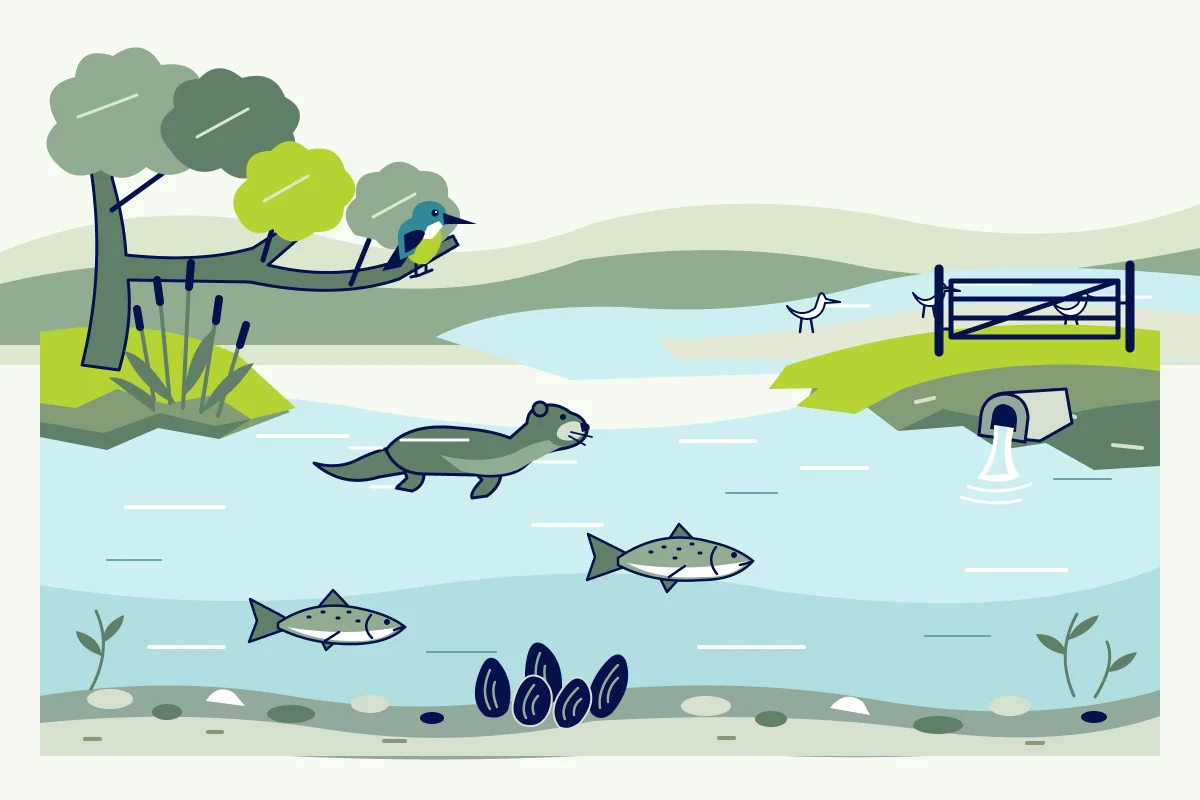
Through a pathway. Screening traces source, pathway and receptor: the works, the route an effect could travel, and the protected habitat or species at the end of it. A drain into a stream that reaches a protected estuary is a pathway; so is a field used by a Special Protection Area's birds. Distance alone does not settle it.
| Pathway | How it links the site | Evidence that settles it |
|---|---|---|
| A. Surface water | A drain or stream from the site reaches the protected river or estuary | Drainage survey, the route along the watercourse and water quality |
| B. Groundwater | Digging, dewatering, soakaways or stored fuel reach water underground | Ground investigation and groundwater flow direction |
| C. Dust and noise | Dust, piling or traffic noise reach habitats or birds nearby | Distances, timing and the sensitivity of the species |
| D. Feeding birds | Fields on or near the site are used by birds from a Special Protection Area | Bird surveys in the season the birds are present |
Screening pre-check
Where the site is, what links it to a European site, and what it is. Nothing is stored or sent.
Answer the three questions to see what to prepare for screening.
How the pre-check decides
| What you choose | What it shows | Why |
|---|---|---|
| Inside or right beside a European site, with any pathway ticked | Plan for a Natura Impact Statement | A significant effect is hard to exclude on objective information when a site is next door and connected |
| Any pathway ticked, or a European site downstream, close by or beside the site | Prepare a screening report | Screening needs objective evidence on each pathway; measures to protect the site cannot be counted |
| Not sure where the nearest European site is, and no pathway ticked | Find the nearest European sites first | The zone of influence follows pathways, not a fixed distance |
| No European site known nearby or downstream, and no pathway ticked | No obvious pathway | The authority still screens every application and records why |
| Each pathway ticked | The evidence that settles it | From the source, pathway and receptor approach |
| A quarry, wind or solar farm, road or waste facility | Check whether an EIAR is needed too | Larger projects may also need environmental impact assessment |
How this works: the source, pathway and receptor approach in the Office of the Planning Regulator's practice note. It shows what to prepare, not a screening determination; only the competent authority can make that.
The Office of the Planning Regulator tells planning authorities to set each project's zone of influence case by case, using source, pathway and receptor, and not by arbitrary distances such as 15 km (OPR, 2021). Where there is no ecological pathway or functional link to a European site, the project can be screened out. Verdé's hydrogeology and noise and air work supplies the evidence on water, dust and noise pathways.
What can screening rely on, and what can it not?
Objective information about the project, the sites and the pathways between them, including effects in combination with other plans and projects. It cannot rely on measures intended to avoid or reduce harm to a European site: under the People Over Wind judgment those belong in the appropriate assessment, so a project that needs them is screened in.
What screening looks at
- The project’s design, size, timing and any emissions or discharges
- Each European site within reach, its qualifying interests and its conservation objectives
- Objective evidence on pathways, such as drainage routes, groundwater flow or birds using nearby land
- Other plans and projects that could act in combination
What it cannot use to screen a project out
- Measures intended to avoid or reduce effects on a European site, such as extra silt controls added for that reason
- A fixed distance, such as everything beyond 15 km
- A conclusion that leaves obvious doubt about significant effects
The site’s own conservation objectives
On 16 July 2026 the EU Court of Justice held, in the Knocknamona and Massey cases, that a valid appropriate assessment cannot be carried out if the site's conservation objectives have not been set, and that screening a site within the project's reach must also take them into account (CJEU, 2026). Each screening report and Natura Impact Statement should name the objectives it was assessed against.
The Office of the Planning Regulator's practice note applies the 2018 People Over Wind judgment (C-323/17), and asks authorities to document every screening, whether or not the applicant submits a report.
What goes into a Natura Impact Statement?
The evidence the authority needs to decide, beyond reasonable scientific doubt, that the project will not adversely affect the integrity of any European site. That means the project, every site within reach and its conservation objectives, baseline surveys, each pathway and effect, other plans and projects, mitigation and monitoring, and a clear conclusion.
What a Natura Impact Statement sets out
- The project: what is built, how and when, and what it emits or discharges
- The European sites within its zone of influence, their qualifying interests and their conservation objectives
- Baseline evidence from desk study and field survey, such as habitats, species, water quality and groundwater
- Each pathway, and the likely effect on each qualifying interest
- Effects in combination with other plans and projects
- Mitigation that avoids or reduces each effect, how it will be delivered and how it will be monitored
- A conclusion on site integrity, with the reasons
Written by competent people, tested for doubt
Section 177T of the 2000 Act requires a Natura Impact Statement to include a report of a scientific examination of evidence and data, carried out by competent persons. Under section 217 of the 2024 Act, the authority asks whether any reasonable scientific doubt remains about the absence of adverse effects on site integrity, and refuses permission if it does, subject to the Act's exception provisions.
What changes for Appropriate Assessment on 26 November 2026?
The law it sits in, not the test. Applications lodged before midnight on 25 November 2026 are processed under the Planning and Development Act 2000, where screening and assessment are in sections 177U and 177V. Applications lodged from 26 November come under Part 6 of the Planning and Development Act 2024, sections 212 and 217.
| Step | Lodged up to 25 November 2026 | Lodged from 26 November 2026 |
|---|---|---|
| The law | Planning and Development Act 2000, Part XAB | Planning and Development Act 2024, Part 6 |
| Screening | Section 177U: an appropriate assessment is required unless a significant effect can be excluded on objective information | Section 212: an appropriate assessment is required where a significant effect cannot be excluded |
| Appropriate assessment | Section 177V: consent only if the project will not adversely affect the integrity of a European site | Section 217: permission refused if reasonable scientific doubt remains about adverse effects on integrity |
| The applicant’s report | Natura Impact Statement | Natura Impact Statement |
| Plans | Natura impact report for development plans | Chapter 2 of Part 6, in force since 2 October 2025 |
The Department of Housing confirmed the date on 12 November 2026: applications lodged before midnight on Wednesday 25 November continue under the 2000 Act (Department of Housing). New regulations start the same day, including rules on requests based on imperative reasons of overriding public interest (draft regulations). If an application is close to the date, Verdé makes sure the screening report or Natura Impact Statement cites the right sections.
What Appropriate Assessment work has Verdé done?
Screening, Natura Impact Statements and the field evidence behind them. Verdé's staff have carried out Appropriate Assessments and Natura Impact Statements in terrestrial, freshwater and marine settings across Ireland, screened a proposed cemetery site under Article 6 alongside a groundwater study, and surveyed freshwater pearl mussels in a Galway river after an oil spill.
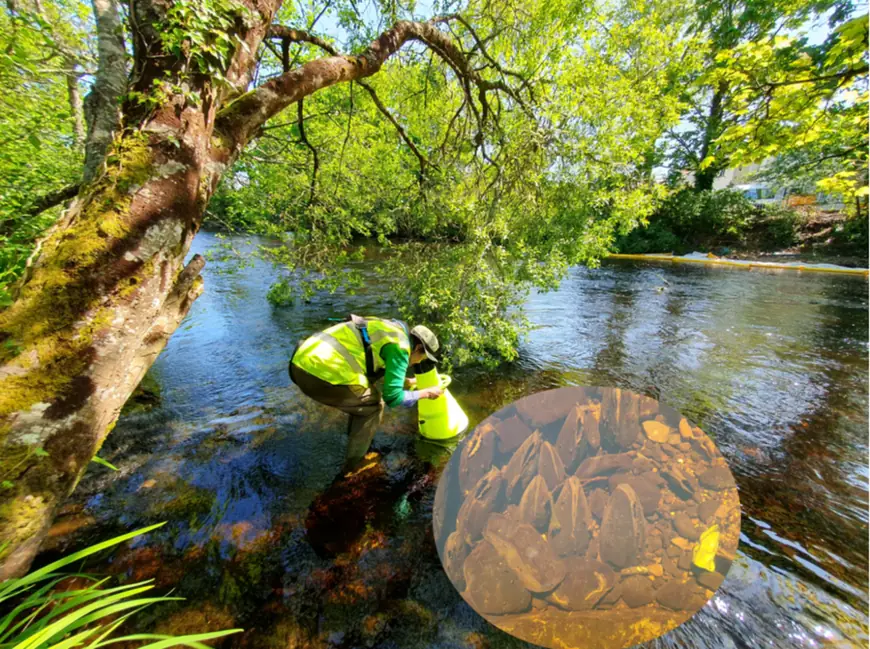
2023, Co. Galway
Freshwater pearl mussel survey after an oil spill
- Dr Gary Canny, Verdé’s Technical Manager, surveyed the river bed with an ecologist from a partner consultancy
- A species protected under the Habitats Directive, checked after an oil spill
2023
- Ecological screening for Appropriate Assessment under Article 6 of the Habitats Directive
- Trial pits, monitoring wells, and groundwater flow direction and travel times
- Separation distances from environmental receptors checked against Irish and UK guidance
2018
- Article 6(3) in full and the four stages, written as clients asked for more assessments on development sites
Appropriate Assessment terms in plain English
Ten terms come up in every screening determination and Natura Impact Statement. Knowing them makes a further information request from the planning authority quicker to read, and makes it clearer what evidence it wants.
- European site
- A Special Area of Conservation or Special Protection Area, part of the EU Natura 2000 network.
- SAC
- Special Area of Conservation: designated under the Habitats Directive for listed habitats and species, such as raised bog, salmon and otter.
- SPA
- Special Protection Area: designated under the Birds Directive for rare and migratory birds and important wetlands.
- Qualifying interests
- The habitats and species a site is designated for.
- Conservation objectives
- What a site must achieve for each qualifying interest, set by the National Parks and Wildlife Service.
- Zone of influence
- The area within which a project could affect a European site, traced through pathways rather than set by distance.
- In combination
- Effects that only become significant when added to those of other plans and projects.
- Site integrity
- Whether a site can keep the habitats and species it is designated for, in line with its conservation objectives.
- Natura Impact Statement
- The applicant’s report for the appropriate assessment.
- IROPI
- Imperative reasons of overriding public interest: the exception that lets a project harming a site go ahead, with compensatory measures.
Questions about Appropriate Assessment
Still have a question? Call 01 201 1260 or email info@verde.ie.
Who carries out an Appropriate Assessment in Ireland?
The competent authority: usually the planning authority, or An Coimisiún Pleanála for appeals and strategic infrastructure. It carries out both the screening and the appropriate assessment. The applicant supplies the information, in a screening report and, where needed, a Natura Impact Statement prepared by competent people such as ecologists and environmental scientists. The authority can ask for further information before deciding.
What is a Natura Impact Statement?
A Natura Impact Statement, or NIS, is the applicant's report for an appropriate assessment. It sets out the implications of the project, alone and in combination with other plans and projects, for each European site in view of its conservation objectives. Irish law requires it to include a scientific examination of evidence and data, carried out by competent persons.
Does every planning application need Appropriate Assessment screening?
Yes. The planning authority screens every application for consent, whether or not the applicant sends a screening report. Where no pathway links the project to a European site, it can be screened out. A screening report is not a legal requirement, but where a site is close by or connected through water, a clear report gives the authority the objective evidence it needs.
Is there a 15 km rule for Appropriate Assessment?
No. The Office of the Planning Regulator says the zone of influence should be set case by case using source, pathway and receptor, not by arbitrary distances such as 15 km, and that a 15 km search should not be used for projects. A project beside a European site with no pathway to it may be screened out, while one far upstream may not.
Can mitigation measures be used to screen out a project?
No. Since the People Over Wind judgment of the EU Court of Justice in 2018, measures intended to avoid or reduce harmful effects on a European site cannot be taken into account at screening. If a project needs them to rule out a significant effect, it is screened in, and the measures are assessed in the Natura Impact Statement instead.
What is the difference between Appropriate Assessment and EIA?
Appropriate Assessment looks only at effects on European sites, under the Habitats Directive, and its test is strict: consent only if site integrity will not be adversely affected, outside the narrow IROPI exception. Environmental impact assessment looks at all of a project's likely significant environmental effects. Many projects need both, and the biodiversity evidence can serve the Natura Impact Statement and the EIAR.
What happens if a project would harm a European site?
It cannot get consent unless it passes the Article 6(4) exception route. There must be no alternative solution, the project must be needed for imperative reasons of overriding public interest, and the State must take compensatory measures and inform the European Commission. Where priority habitats or species are affected, the reasons allowed are narrower, and some need an opinion from the Commission.
What changes for Appropriate Assessment on 26 November 2026?
The law it sits in, not the test. Applications lodged before midnight on 25 November 2026 continue under the Planning and Development Act 2000, sections 177U and 177V. Applications lodged from 26 November come under Part 6 of the Planning and Development Act 2024, with screening in section 212 and the appropriate assessment in section 217. A Natura Impact Statement is still the applicant's report.
What does Verdé need to start?
Four things: the site location with a red-line boundary, a description of the project and how it will be built, how surface water and wastewater will be handled, and the programme for lodging the application. With those, Verdé identifies the European sites within reach and the likely pathways, advises on screening or a Natura Impact Statement, and replies within one working day.
Sources and further reading
- Council Directive 92/43/EEC on the conservation of natural habitats and of wild fauna and flora (the Habitats Directive)EUR-Lex, Official Journal of the European Union, 1992. Article 6(3), the appropriate assessment test, and Article 6(4), the exception route.
- Planning and Development Act 2000, section 177U: screening for appropriate assessmentLaw Reform Commission, Revised Acts, checked 24 November 2026. Who screens, and the objective-information test, for applications lodged up to 25 November 2026.
- Planning and Development Act 2024, section 212: screening for appropriate assessment of relevant developmentIrish Statute Book, 2024. Screening under the 2024 Act, for applications lodged from 26 November 2026.
- Confirmation of the commencement date for the 2024 ActDepartment of Housing, Local Government and Heritage, 2026. The rest of the 2024 Act, including Part 6, applies from 26 November 2026.
- Appropriate Assessment Screening for Development Management, Practice Note PN01Office of the Planning Regulator, 2021. Source, pathway and receptor, no 15 km rule, and no mitigation at screening.
- Knocknamona and Massey, joined cases C-27/25 and C-356/25, judgment of 16 July 2026 (monthly case-law digest)Court of Justice of the European Union, 2026. A valid appropriate assessment needs the site’s own conservation objectives.
- Appropriate Assessment of Plans and Projects in Ireland: Guidance for Planning AuthoritiesDepartment of the Environment, Heritage and Local Government, 2009, revised 2010. The stages of Appropriate Assessment.
- Environmental Indicators Ireland 2025: BiodiversityCentral Statistics Office, 2025. How much of Ireland’s land is SAC and SPA.
What happens when you send the site details
What we ask for
- Site location with a red-line boundary
- A description of the project and how it will be built
- How surface water and wastewater will be handled
- The programme for lodging the application
Reply
Within one working day, with the European sites within reach, the likely pathways, and whether a screening report or a Natura Impact Statement fits.
Phone 01 201 1260 or email info@verde.ie
Verdé guides on Appropriate Assessment
- What IROPI means in an Appropriate AssessmentThe Article 6(4) exception, test by test.
- Appropriate Assessment: Verdé’s 2018 guideArticle 6(3) and the four stages.
- Freshwater pearl mussel survey in Co. GalwayA protected species survey after an oil spill.
- Environmental Impact Assessment: Verdé’s guideEIA and the EIAR from design to decision.
Related Verdé services
- Environmental impact assessment in Ireland: when you need an EIARThe wider assessment many projects also need.
- Hydrogeology in Ireland: abstraction, models, protection, monitoringSurface water and groundwater pathways.
- Noise, air, odour and vibration assessments in IrelandDust and noise evidence.
- Environmental monitoring and compliance in IrelandMonitoring that conditions or a NIS can require.
- Renewable energy consultancy in IrelandWind and solar projects near protected sites.
- Environmental consultancy in Ireland, from first survey to sign-offEvery Verdé service by project stage.