
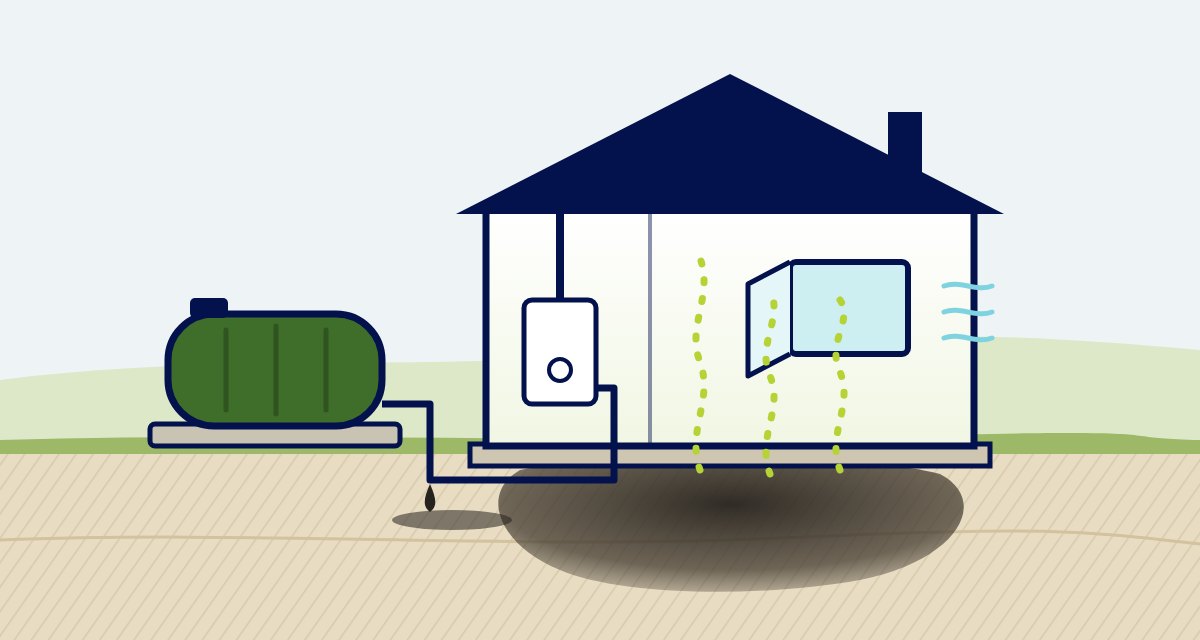
A smell of kerosene in the house is worth acting on the same day. In an Irish home it nearly always comes from heating oil escaping somewhere between the tank and the boiler, or from oil that has already soaked into the ground beside or under the house. This guide sets out where the smell usually comes from, how to narrow it down safely, what to do now, and when to call for help.
Is a kerosene smell in the house dangerous?
It can be, so treat it as a sign of a leak to find. Kerosene vapour is flammable: keep naked flames, cigarettes and anything that sparks away from a strong smell. The UK Health Security Agency describes the vapour as mildly irritating to the airways and unlikely to be fatal, but warns that high levels in a warm, enclosed space can cause confusion (UKHSA, 2024). Anyone who feels unwell should get into fresh air and seek medical advice.
What causes a kerosene smell in the house?
Where the smell is strongest is the best clue. A smell is often the first sign of a leak, before a stain or a puddle appears, and it does not tell you how much oil has escaped.
- Tank, valve or filter
- Oil line to the house
- Boiler or its oil supply
- Fill point after a delivery
- A drain or gully
- Vapour from oil under the floor
Where the smell is strongest, what it usually means and what to check.
Outside, at the tank
What it usually means: A leak from the tank, a fitting, the valve or the filter
What to check: Damp or oily patches under the tank, small drips, splits, cracks, sun bleaching, and rust on a metal tank
Along the oil line, or where it enters the house
What it usually means: A leak from the line or a joint, often buried and out of sight
What to check: Damp or stained ground or walls along the route, and an oil level dropping faster than you use it
In the boiler room, utility or hot press
What it usually means: A leak at the boiler's oil supply or filter, or a boiler that is not burning cleanly
What to check: Oil under the boiler, soot or staining around it or the flue, and when it was last serviced
Just after an oil delivery
What it usually means: Oil spilled at the fill point, or a tank that overfilled
What to check: Fresh oil on the tank, the ground or the wall near the fill pipe
From a sink, drain or gully
What it usually means: Oil that has reached a drain, or a spill that was washed into one
What to check: A sheen or oil in gullies and manholes; never flush it away
Indoors, with nothing to see, and it keeps coming back
What it usually means: Oil in the ground under or beside the house, giving off vapour
What to check: Ground floor rooms, floor joints and any past leak, even one that was repaired
| Where you smell it | What it usually means | What to check |
|---|---|---|
| Outside, at the tank | A leak from the tank, a fitting, the valve or the filter | Damp or oily patches under the tank, small drips, splits, cracks, sun bleaching, and rust on a metal tank |
| Along the oil line, or where it enters the house | A leak from the line or a joint, often buried and out of sight | Damp or stained ground or walls along the route, and an oil level dropping faster than you use it |
| In the boiler room, utility or hot press | A leak at the boiler's oil supply or filter, or a boiler that is not burning cleanly | Oil under the boiler, soot or staining around it or the flue, and when it was last serviced |
| Just after an oil delivery | Oil spilled at the fill point, or a tank that overfilled | Fresh oil on the tank, the ground or the wall near the fill pipe |
| From a sink, drain or gully | Oil that has reached a drain, or a spill that was washed into one | A sheen or oil in gullies and manholes; never flush it away |
| Indoors, with nothing to see, and it keeps coming back | Oil in the ground under or beside the house, giving off vapour | Ground floor rooms, floor joints and any past leak, even one that was repaired |
The tank checks in the first rows follow Clare County Council's list of signs: a strong oil smell where the tank or pipework is, damp oily patches under the tank, a small irregular drip, and splits, cracks or rust (Clare County Council).
What to do if you smell kerosene in the house
Make it safe
Open windows and doors, put out naked flames and cigarettes, and keep anything that sparks away from a strong smell. Keep children and pets out of the area.
Turn the heating off
Switch the boiler off so it does not fire, and leave it off until the smell has been traced and fixed.
Look for the source
Check the tank, its valve and filter, the line where you can see it, and the boiler for wet, dark or shiny patches, drips or fresh staining. Do not dig or move oil-soaked material.
Stop the flow, only if safe
If you find a leak and can reach the tank valve safely, close it. Catch drips in a container and keep oil out of drains; never hose it away.
Call for help
For a strong or lasting smell, oil you can see, or oil near a drain, ditch or well, call 0818 714 002 at any hour. For a boiler that smells of burning or soot, call a qualified oil boiler technician before using it again.
Tell your insurer
If oil has escaped, photograph what you find and tell your insurer or broker as soon as you can. Our guide to oil spill insurance claims explains the steps.
Do and do not, while you wait
Do
- Keep the windows open and the heating off
- Close the tank valve if you can reach it safely
- Catch drips in a container and keep oil away from drains
- Photograph the tank, the line and any oil you find
Do not
- Light a fire, smoke or use anything that sparks near a strong smell
- Hose oil away or pour water or detergent on it
- Run a boiler that smells of burning or soot
- Mask the smell with air fresheners and wait for it to pass
When is a kerosene smell an emergency?
- The smell is strong, or getting stronger.
- You can see oil on the ground, on a wall or on the floor.
- Oil has reached a drain, a ditch, a stream or a well.
- The oil level in the tank has dropped faster than you have used it.
- Anyone in the house feels unwell: get them into fresh air first.
Any one of these is enough to call our 24/7 line on 0818 714 002; the duty engineer talks you through the first steps on the call and confirms the response. If oil has reached a river or stream, report it to Inland Fisheries Ireland on 0818 34 74 24 (IFI). If it could reach a public water supply or the public sewer, Clare County Council's advice is to contact Uisce Éireann on 1800 278 278 (Clare County Council).
Why does the kerosene smell keep coming back?
A smell that returns after the tank or line has been repaired usually means oil is still in the ground. Kerosene that soaks into soil beside or under a house goes on giving off vapour, and that vapour can reach the rooms above. On our insurance work, oil odours inside a house are a sign that the oil may have reached under the building: boreholes drilled inside and outside show how far it has gone, and the clean-up is signed off only once indoor air has been checked along with the soil and water.
Three of our 2024 cases where the oil reached under a building.
Home in Co. Westmeath
What happened: Over 600 litres escaped, reaching neighbouring land, the septic tank and beneath the house
What the clean-up involved: 180 tonnes of contaminated material removed, validated by soil, water and air sampling
Home in Co. Longford
What happened: Kerosene from an underground oil line fitting spread beneath about half the building
What the clean-up involved: Concrete flooring broken out, and foundation walls propped, removed and replaced
Hospital plant room
What happened: 4,500 litres of light fuel oil from a fractured fuel line closed the physiotherapy department
What the clean-up involved: Vapour extraction and soil vapour extraction let the department reopen
| Case | What happened | What the clean-up involved |
|---|---|---|
| Home in Co. Westmeath | Over 600 litres escaped, reaching neighbouring land, the septic tank and beneath the house | 180 tonnes of contaminated material removed, validated by soil, water and air sampling |
| Home in Co. Longford | Kerosene from an underground oil line fitting spread beneath about half the building | Concrete flooring broken out, and foundation walls propped, removed and replaced |
| Hospital plant room | 4,500 litres of light fuel oil from a fractured fuel line closed the physiotherapy department | Vapour extraction and soil vapour extraction let the department reopen |
How to stop a kerosene smell happening again
- Check the tank, the line to the house, the connections, the bund and the filter regularly, as Clare County Council advises (Clare County Council).
- Have the oil boiler serviced every 12 months.
- Order oil before the tank runs dry, so grit from the bottom of the tank does not damage the pipework.
- Fit a carbon monoxide alarm that meets EN 50291 in every room with a fuel-burning appliance, and one within 5 metres of every bedroom (Gas Networks Ireland).
- If the tank is cracked, bleached or rusting, get advice on replacing it before it fails.