
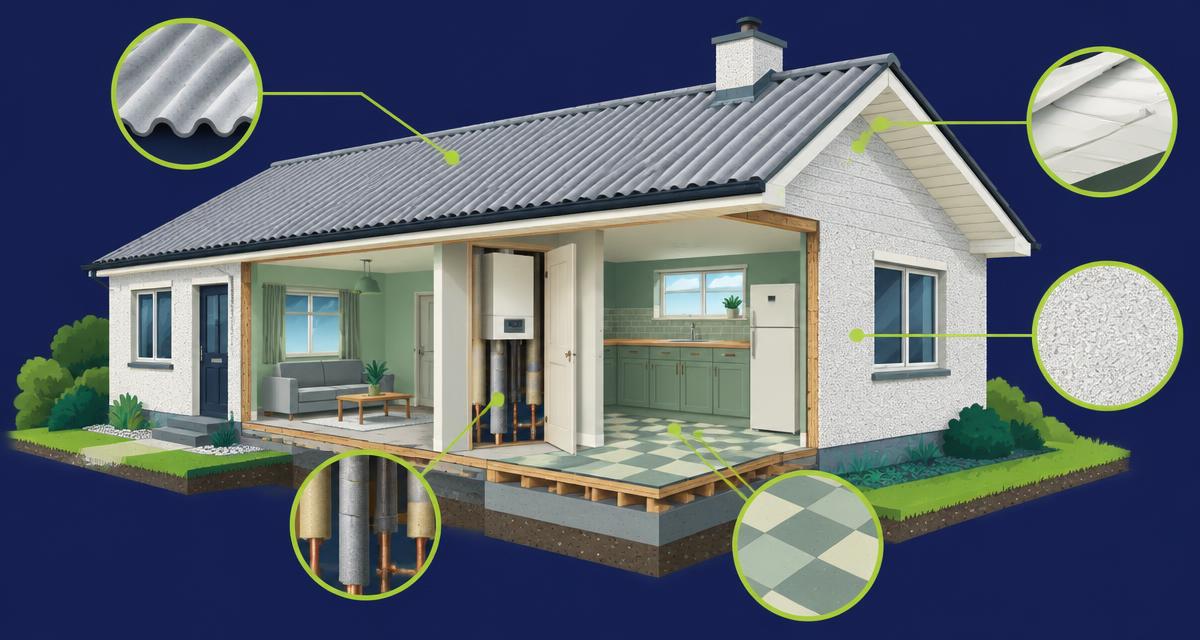
The honest answer to “what does asbestos look like?” is that you can't tell by looking. Asbestos fibres are invisible in the materials that contain them, and the cement sheets, coatings and tiles that contain asbestos look much like the versions that don't. What you can do is learn which materials in Irish buildings commonly contain it, check the age of your building, and arrange proper testing before any work disturbs them.
Start with the age of the building
The HSA says asbestos can be found in buildings built or refurbished before 2004, and its demolition and refurbishment safety alert highlights pre-2000 buildings as a particular concern. Building age is a starting point, not proof that asbestos is present or absent — but if your home, shed or workplace predates 2004, treat the materials below as suspect until a competent person confirms otherwise.
The materials where asbestos hides in Irish buildings
These are the locations the EPA's asbestos guidance lists for Irish homes, farms and workplaces. If you recognise one of these in a pre-2004 building, leave it alone and get advice before disturbing it.
| Material | Where you'll see it |
|---|---|
| Corrugated roof sheets | Asbestos cement sheets on sheds, garages, farm buildings and older extensions |
| Soffits, gutters and downpipes | Asbestos insulating board or cement under the eaves, and cement gutters and downpipes |
| Textured ceilings and walls | Textured decorative coatings, often called Artex, on ceilings and walls |
| Water tanks | Asbestos cement water tanks, usually in the attic |
| Insulating board (AIB) | Around boilers and heaters, in partition walls, ceiling tiles and fire-door panels |
| Pipe and boiler lagging | Lagging on hot-water pipes and boilers — check the hot press, the attic and under floors |
| Vinyl floor tiles | Older vinyl floor tiles, often in kitchens, halls and bathrooms |
| Flues | Asbestos cement flue pipes from boilers and heaters |
In commercial and industrial buildings, also look for sprayed coatings on beams, columns and ceilings, loose-fill insulation, and rope seals and gaskets on plant.
Why appearance can't confirm it
An asbestos cement roof sheet looks like a fibre-cement roof sheet. Old vinyl tiles with asbestos look like old vinyl tiles without it. The only way to know whether a material contains asbestos is sampling and analysis, and the HSA says sampling of suspect materials must only be undertaken by a competent person or company. Do not take your own samples.
If you think you've found asbestos
Do
- Leave it alone, and keep people away if it's damaged.
- Tell anyone who'll work on the building, including builders, electricians and plumbers.
- Get an asbestos survey before any work that could disturb it.
Do not
- Drill, sand, cut, scrape or break it.
- Sweep or vacuum up dust or debris from it.
- Put it in a household bin or skip — asbestos waste must go to a permitted collector.
The safe next step
An asbestos survey identifies suspect materials and helps you plan how to manage them safely before building work. You'll usually need one if you're renovating, refitting or extending, demolishing all or part of a building, or running a workplace in an older building — the HSA says workplaces built before 2004 need an asbestos risk assessment, a management survey and a management plan. Verdé provides asbestos surveys, air clearance testing and asbestos management-plan support in Ireland through its occupational hygiene service, with offices in Kilcoole, Co. Wicklow, Castlebar, Co. Mayo and Cork.