How much electricity does a solar panel actually produce in Ireland? It is the first question every commercial client asks, and the honest answer is that Irish yield is predictable — it is simply lower per installed kilowatt than in southern Europe, and far better than most people expect. This guide sets out how Verdé's engineers calculate expected yield for Irish sites.
The basic yield equation
Annual output is estimated as:
Annual kWh = Installed capacity (kWp) × Specific yield (kWh/kWp/yr) × Performance ratio adjustments
Specific yield is the site-specific figure that does the heavy lifting. It is derived from irradiation data for the location, then adjusted for orientation, tilt, shading, temperature and system losses.
Irradiation in the Irish climate
Ireland sits between roughly 51.4° and 55.4° north. Horizontal irradiation is typically in the region of 900–1,100 kWh/m² per year, with the south and south-east (Wexford, Waterford, Cork) receiving more than the north-west. Cloud cover, not latitude alone, is the dominant limiting factor: Irish skies are diffuse for much of the year, which means panels generate steadily across long daylight hours rather than in short intense peaks.
We size systems using the European Commission's PVGIS dataset (re.jrc.ec.europa.eu) as the irradiation source, cross-checked against Met Éireann observations and, where available, on-site metering.
What that means per panel
For a well-oriented, unshaded Irish roof, specific yield generally lands in the 850–950 kWh/kWp per year band. Applying that to common module sizes:
| Module rating | Indicative annual output |
|---|---|
| 400 Wp | ≈ 340–380 kWh |
| 440 Wp | ≈ 375–420 kWh |
| 500 Wp | ≈ 425–475 kWh |
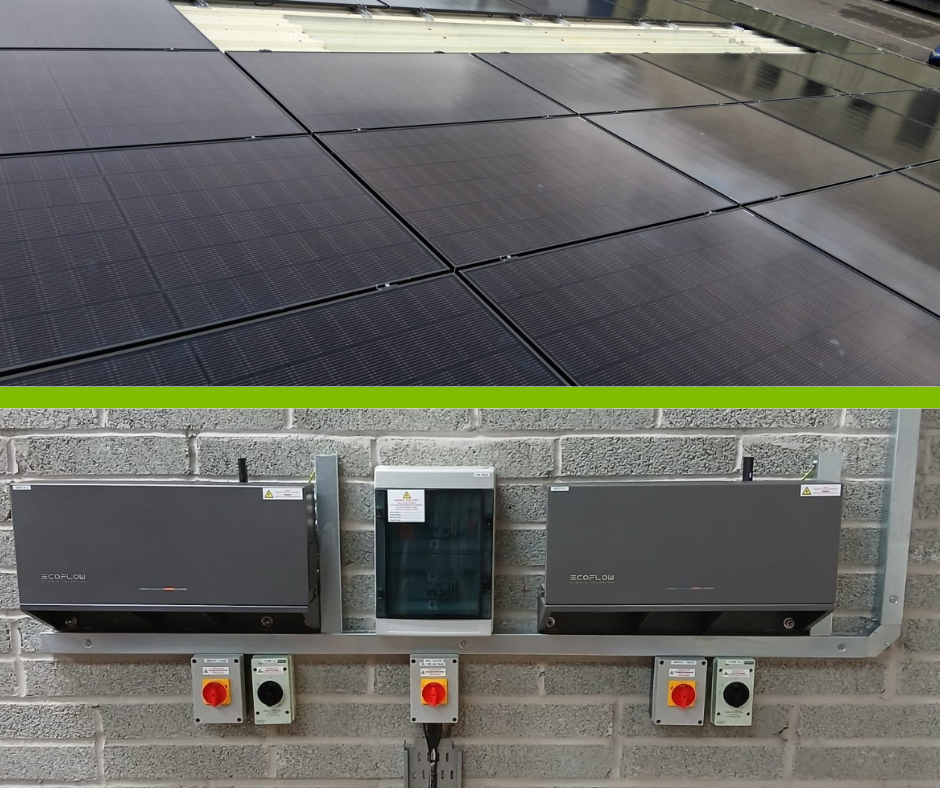
So a single modern panel in Ireland produces roughly a third of a megawatt-hour a year — about the annual consumption of a large fridge-freezer plus a washing machine. A 10 kWp commercial array, of the scale Verdé designed for a Wicklow client, would be expected to generate in the order of 8,500–9,500 kWh annually.
The five factors that move the number
1. Orientation and tilt
Due south at 30–40° tilt is optimal at Irish latitudes. East–west split arrays typically give up around 10–20% of annual yield, but flatten the generation curve across the day — which often suits a factory or office load profile better than a south-facing peak at noon.
2. Shading
Shading is the single most damaging and most underestimated loss. A partially shaded string can lose far more output than the shaded area alone would suggest. We survey with a shading analyser and model near and far obstructions before finalising string layouts; power optimisers or module-level MPPT are specified where obstruction cannot be designed out.
3. Temperature
Panels are rated at 25°C cell temperature and lose output as they heat up. The Irish climate is genuinely advantageous here — cool, breezy conditions keep modules closer to their rated efficiency than in hotter markets, partly offsetting lower irradiation.
4. System losses
Inverter conversion, DC and AC cabling, mismatch and soiling typically account for a combined 12–18% loss. Verdé models these explicitly rather than applying a single blanket derating figure.
5. Degradation
Modules lose output slowly over their life; manufacturer warranties commonly guarantee around 80–90% of rated output at year 25. Any 20-year financial model should include an annual degradation assumption rather than a flat yield.
Self-consumption is what determines the business case
For commercial and industrial clients, yield is only half the picture. What matters financially is the share of generation consumed on site, displacing imported electricity at the full retail unit rate, versus exported units. Sites with strong daytime load — manufacturing, cold storage, hospitality, schools, data-adjacent facilities — routinely self-consume the majority of generation and see the shortest payback.
This is why Verdé begins every commercial feasibility study with half-hourly consumption data rather than roof area. Matching the array to the load profile, and considering storage only where the modelling justifies it, produces a more defensible investment case than maximising installed capacity.
Planning and grid considerations
Rooftop solar in Ireland benefits from substantially relaxed planning exemptions, though limits and conditions vary by building type and location, and specific restrictions apply near aerodromes and in certain designated areas. Grid connection requirements also differ by system size. Both should be confirmed for the individual site at feasibility stage.
Grant supports for businesses and homeowners are administered by SEAI; current terms and eligibility are published at seai.ie.
How Verdé approaches a yield assessment
- Collect half-hourly consumption data and tariff structure.
- Model site-specific irradiation, orientation, tilt and shading.
- Apply temperature, system-loss and degradation assumptions transparently.
- Produce generation, self-consumption and export projections.
- Set out the capital cost, supports and lifetime financial case.
Figures in this guide are indicative planning-stage ranges intended to frame expectations. Site-specific modelling is required before any investment decision.